

If you’re a man trying bondage for the first time, start with padded cuffs or bondage tape instead of metal or rope, negotiate a safeword before anything happens, and keep safety shears within reach. Keep your first scene short, a short duration is plenty, and build in aftercare afterward. That combination protects your skin, your nerves, and your confidence while you figure out what you actually like.
TL;DR:
- Padded cuffs and bondage tape are the safest and most comfortable restraints for beginners, as they distribute pressure and are easy to release.
- Safety checks like the two-finger test and circulation color return are essential, and restraints should never be too tight or restrict movement or blood flow.
- Starting with short scenes, clear communication, and established safewords reduces risk and helps build confidence and trust between partners.
- Rope bondage for men requires longer lengths and attention to anatomy, with proper training or mentorship strongly recommended before attempting advanced ties.
- Regular aftercare, including hydration, reassurance, and honest discussion, is vital for emotional and physical well-being after bondage scenes.
Table of Contents
- Beginner-Friendly Gear for Men: What to Buy First and Why
- Safety, Consent, and Aftercare Every Man Must Know
- How to Choose Restraints for Men: Fit, Materials, and What to Avoid
- Rope Bondage and Shibari Basics for Men (What’s Different, What to Learn First)
- Simple Starter Scenes and Practice Plan for Men
- The Mindset Behind Bondage for Men
- Common Positions and Techniques for Men
- Talking About Bondage: Communication Tips for Men
- Sensory Play That Pairs Well With Bondage
- Addressing Common Fears About Bondage for Men
- Normalizing Beginner Uncertainty
- How Playful Cove Helps Men Get Started Safely
- Sources
- FAQ
Beginner-Friendly Gear for Men: What to Buy First and Why
The gear you choose determines how relaxed your first scene feels. Softer, wider restraints spread pressure across more skin, which matters more for men than most guides admit. Wider wrists, thicker forearms, and denser muscle mass mean a thin strap or a zip tie can dig in fast and unevenly.
Padded cuffs are the safest starting point for a reason: they’re forgiving on skin, quick to release, and adjustable enough to fit different builds. Bondage tape, the kind that only sticks to itself, is another smart beginner choice because it never pinches and peels off cleanly. Soft ties made from silk or cotton work well for men who want something that feels more intimate than gear-store hardware. Under-bed restraint systems are worth considering if you want four-point positioning without drilling anything into a wall.
Here’s how the common beginner options stack up:
- Padded cuffs: comfortable, adjustable, and reusable, but slightly bulkier than tape.
- Bondage tape: cheap, disposable, and gentle on skin, though less secure for longer scenes.
- Soft cloth ties: intimate and quiet, but harder to release quickly with one hand.
- Under-bed systems: great for full-body positioning, but require a compatible bed frame.
Skip metal handcuffs, zip ties, and improvised belts early on. Metal doesn’t flex, offers zero pressure distribution, and often has no true quick-release mechanism, which turns a minor mistake into a real injury risk. Belts and zip ties are worse: no give, sharp edges, and no way to loosen them without cutting.
For a first purchase, the Boundless Wrist Cuffs hit the padded, adjustable, quick-release checklist without overcomplicating things. If you want something plusher, the Master Series Cuffed In Fur Furry Handcuffs add a soft lining that’s forgiving even during longer scenes.
Safety, Consent, and Aftercare Every Man Must Know
Two frameworks guide almost all responsible bondage play: SSC (safe, sane, and consensual) and RACK (risk-aware consensual kink). SSC assumes activities should stay within a “safe” boundary; RACK acknowledges that some kink carries inherent risk and asks partners to understand and accept that risk together rather than pretend it doesn’t exist. Either framework only works if you talk through limits, roles, and stop signals before anything starts.
Once restraints are on, run these checks:
- Two-finger test: you should be able to slide two fingers under any cuff or rope. If you can’t, it’s too tight.
- Thumbnail-flick test: press a fingernail and release; color should return within a couple of seconds. Slow color return signals restricted circulation.
- Watch for tingling, numbness, or color changes, especially at the wrists and hands, and release immediately if any appear.
Injury risk in bondage is real and worth taking seriously. Medical News Today reports that a notable proportion of BDSM participants in one study experienced at least one accident, most commonly bruising, and that strangulation is a common cause in fatal cases, often involving alcohol or drugs. That’s the strongest argument for staying sober during scenes and never experimenting with breath play without real training.
Aftercare closes the loop. Wikipedia’s overview of BDSM aftercare describes it as dedicated time for emotional and physical reconnection, water, a snack, a blanket, and quiet conversation about how the scene felt. Ask your partner directly: “How are you feeling? Anything sore? Anything you want to talk through?” Playful Cove’s own BDSM aftercare guide walks through fuller routines for both roles.
How to Choose Restraints for Men: Fit, Materials, and What to Avoid
Fit matters more than style. A cuff that’s perfect for one wrist size can dig into a thicker forearm, so check adjustability before anything else. Material changes the experience too: leather feels substantial and molds to the body over time, neoprene is washable and great for sweatier scenes, and padded fabric is the softest option for sensitive skin or longer wear.
Before buying, run through this checklist:
- Does it have a quick-release buckle or clasp you can open with one hand?
- Is the padding thick enough to pass the two-finger test comfortably?
- Is it rated for restraint only, not suspension, unless you’ve confirmed otherwise?
- Can you adjust it for a bigger wrist, forearm, or ankle without straining the material?
Beginner cuffs are built for restraint, not for bearing body weight. Suspension work needs hardware rated for that load, plus training most men don’t have yet. Don’t test that limit on gear designed for bedposts and headboards.
Pro Tip: Buy two sets of cuffs before you buy rope. Wrist and ankle cuffs let you experiment with full-body positioning long before you need to learn a single knot.
Rope Bondage and Shibari Basics for Men (What’s Different, What to Learn First)
Rope changes the equation. Shibari guides built around male anatomy point out that broader shoulders and flatter chests often need longer lengths and different tie patterns than techniques designed around female bodies. Expect to want 6 to 8mm diameter soft cotton or hemp rope in 8 to 10 meter lengths for most chest and torso ties on a male build.
Two risks deserve real attention. Rope across the sternum can restrict breathing faster than expected on a broader chest, and the radial nerve, which runs along the outer forearm, is easy to compress with an overtight wrap. Lunarness’s guide to male shibari recommends checking wrist and hand sensation constantly, not just at the start.
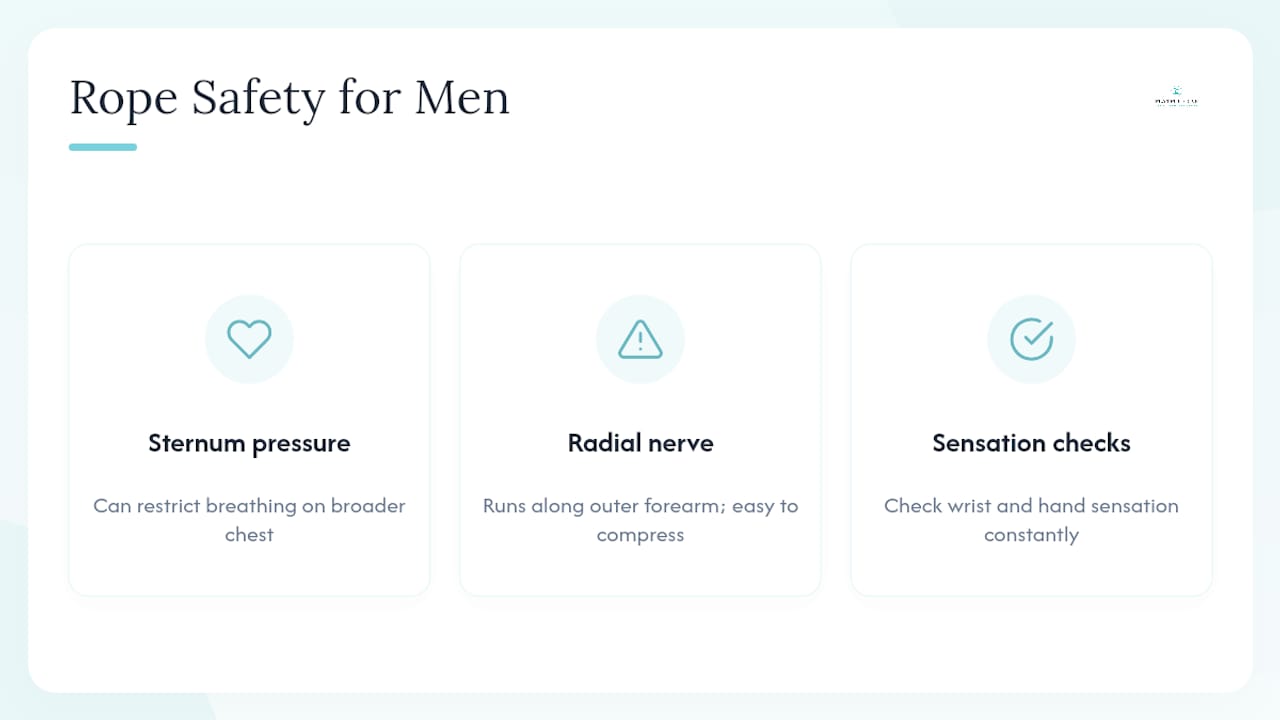
Rope has a real learning curve. A local workshop or an experienced community mentor will teach you more in one session than months of solo video watching, and it’s worth seeking that out before attempting your first chest harness.
Simple Starter Scenes and Practice Plan for Men
A first scene works best when it’s short and fully mapped out beforehand. Talk through roles, hard limits, your safeword, and a nonverbal signal for anyone who might have their mouth covered or gagged later. Playful Cove’s safe-words list and negotiation script gives you ready language if you’re not sure where to start that conversation.
For the scene itself:
- Lay out your safety kit: EMT-style trauma shears, your phone, Mood Lube, and cuffs with visible quick-release buckles.
- Restrain one limb at a time and run the two-finger test on each cuff before moving on.
- Keep the scene to a short period for your first attempt.
- Check in verbally at least once during the scene, even if everything seems fine.
- Release fully, then move straight into aftercare.
Pro Tip: Set a phone timer for your first scene instead of guessing. Ten minutes feels a lot longer once someone’s restrained, and that’s a good thing to learn early.
The Mindset Behind Bondage for Men
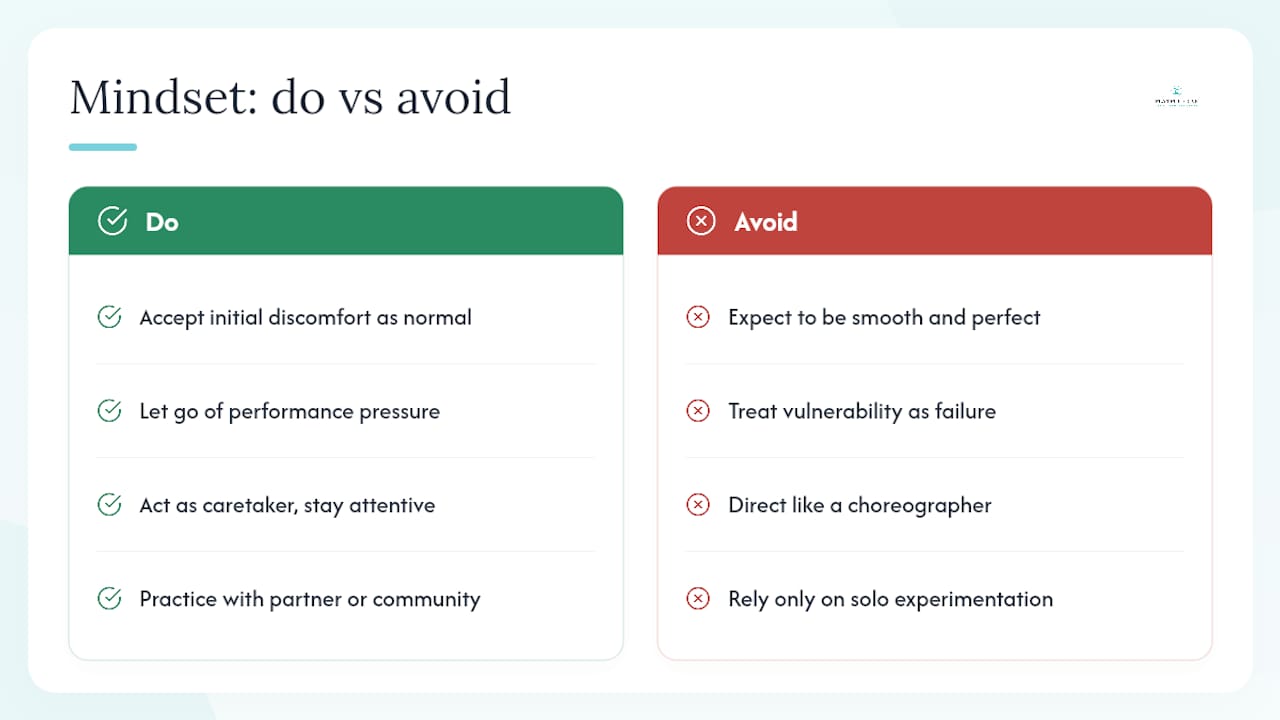
Bondage asks something specific of men that other sexual experiences often don’t: giving up visible control, or taking control of someone else’s vulnerability, in a culture that rarely gives men scripts for either. That discomfort is normal, and it usually fades once you realize bondage isn’t a performance with a right answer.
A lot of first-timers carry an unspoken expectation to be smooth, confident, and instinctively skilled, mostly because media portrayals skip the awkward fumbling with buckles and the “wait, is this too tight?” pauses. Real scenes involve exactly that fumbling. Letting go of the performance pressure is often the single biggest thing that improves a man’s first few experiences with restraint, on either side of the rope.
If you’re stepping into the dominant role for the first time, it helps to think of yourself as a caretaker with temporary authority, not a director running a scene. Attentiveness reads as far more confident than choreography does. If you’re the one being restrained, the vulnerability can bring up feelings you didn’t expect, a flood of trust, sometimes tears, sometimes laughter. None of that means something went wrong.
Practicing with a partner willing to switch roles, or in a supervised community setting, tends to build both skill and comfort faster than solo experimentation. You get real feedback in the moment, which is hard to replicate any other way.
Common Positions and Techniques for Men
Start with positions that keep major joints in a natural range and put no weight on the restrained limbs. Wrists cuffed to a headboard with legs free is about as low-risk as bondage gets, and it still delivers the psychological weight of restriction without any real physical risk.
Hogtie-style positions (wrists and ankles connected behind the back) look dramatic but demand more caution for men with broader shoulders or limited hip flexibility. Skip these until you’ve built confidence with simpler ties. A spread-eagle position, four limbs cuffed to separate anchor points, works well with an under-bed system and gives your partner full access without bunching pressure on any single limb.
For seated or kneeling positions, watch knee and shoulder strain more closely than you would with someone lying down; men with less flexibility in the hips often find kneeling restraint uncomfortable within minutes, well before any restraint fails. Chest harnesses using rope are more advanced and should wait until you’ve learned sternum-pressure awareness, covered in the rope section above.
Whatever position you choose, build in a way to check on your partner’s face and breathing. Positions that turn someone fully away from you make verbal check-ins your only safety tool, so reserve those for later once you’ve built trust and a reliable safeword rhythm together.
Talking About Bondage: Communication Tips for Men
Men are frequently socialized to treat asking questions as a weakness, and that instinct works against you here. The negotiation conversation before a scene isn’t a formality, it’s the actual foundation the whole experience rests on.
Be specific rather than vague. “I’m curious about being restrained” opens a conversation; “I want my wrists cuffed to the headboard for ten minutes with a safeword” gives your partner something concrete to respond to. Ask directly about limits you might not think to guess: past injuries, claustrophobia, sensitive areas, and anything from a previous relationship that left a bad association.
During the scene, check in with short, clear questions rather than long sentences that are hard to answer while restrained: “Good?” “Too tight?” “Keep going?” Establish a nonverbal signal, like dropping a held object or tapping a surface twice, for moments when speaking isn’t possible. Afterward, talk honestly about what worked and what didn’t. That conversation, more than any single technique, is what improves your next scene.
Sensory Play That Pairs Well With Bondage
Restriction sharpens the other senses almost automatically, which is why bondage pairs so naturally with sensory add ons. Blindfolds are the most common starting point because removing sight amplifies touch and sound almost instantly, often more intensely than either partner expects the first time.
Temperature play, warm massage oil followed by a cool hand or ice cube, adds contrast that feels dramatic against skin that’s already hyperaware from restriction. Light scratching, feather ticklers, or the contrast between a soft glove and bare fingertips give a restrained partner unpredictable input they can’t brace for, which is often where the real intensity comes from.
Sound matters more than most beginners expect. A quiet room amplifies breathing and small movements, while music can either build tension or defuse nervousness depending on the pairing. Some men find a light massage using a warming oil before restraint helps ease initial nerves, easing someone into a relaxed state before introducing any restriction at all.
Keep sensory additions simple for a first few scenes. Layering blindfold, temperature, and unfamiliar restraint all at once can overwhelm a partner who’s still learning to trust the safeword system. Add one new element at a time and let the aftercare conversation tell you what to try next.
Addressing Common Fears About Bondage for Men
The most common fear men voice, often quietly, is about their own body: worry that broader shoulders, larger builds, or less flexibility will make bondage awkward or impossible. It won’t. The techniques and gear covered throughout this guide exist specifically because male anatomy needs its own adjustments, not because bondage doesn’t work for men’s bodies.
A second common fear centers on masculinity itself, the idea that wanting to be restrained, or wanting to restrain someone gently rather than aggressively, contradicts some expectation of toughness. That expectation is outdated and has nothing to do with what actually makes bondage satisfying. Trust and attentiveness are the real skills here, not physical dominance.
Fear of injury is legitimate and worth respecting rather than dismissing. That’s exactly why the fit checks, circulation tests, and soft-gear recommendations throughout this guide exist. Followed consistently, they address nearly every realistic risk a beginner will encounter.
Finally, many men worry they’ll do something “wrong” on a first attempt. There’s no test to pass. A slightly clumsy first scene with a safeword, a fit check, and honest aftercare is a complete success, regardless of how smooth it looked.
Normalizing Beginner Uncertainty
Feeling unsure the first time you pick up a cuff or a coil of rope isn’t a warning sign, it’s just what learning looks like. Curiosity and honest conversation with your partner matter more than getting a knot perfect. Treat safety checks and aftercare as the real core of good play, not the fine print around it, and the rest follows naturally.
— Playful Cove Editorial Team
How Playful Cove Helps Men Get Started Safely
Some retailers offer gear that is forgiving on skin, easy to release, and priced for experimenting rather than committing. Where a specialty bondage shop can overwhelm you with rope grades and rigging hardware you don’t need yet, Playful Cove keeps the starter category focused on what actually works for a first scene.

The Boundless Wrist Cuffs and Master Series Cuffed In Fur Furry Handcuffs both meet the padded, quick-release criteria covered earlier, and either makes a solid first purchase. If you’d rather ease into the conversation before any restraint happens, the Fetish Fun Explore Kinky Satisfaction and Bondage Action! Board Game gives you and a partner a low-pressure way to talk through preferences out loud. Round out your kit with Mood Lube to keep skin comfortable during longer scenes, and if you’re exploring intimacy beyond bondage itself, the Naked Addiction Silicone Rechargeable Thrusting, Vibrating, and Rotating Dildo is worth a look as a couples add on.
For the conversation side of things, Playful Cove’s safe-words list and negotiation script and full aftercare guide are free to read anytime. Browse beginner restraint collections online to put together a starter kit that fits your comfort level.
Sources
These sources back the safety, aftercare, and rope guidance throughout this article: The Cut on beginner restraint choices, Medical News Today on injury data, Wikipedia on aftercare, and SparkChambers on starter gear. If a scene brings up distress, 988 Lifeline offers free crisis support.
- How to tie someone up: what beginners to bondage should know — The Cut
- Bondage sex: Benefits, tips, and how to perform — Medical News Today
FAQ
Is Bondage Safe for Beginners to Try Alone?
It’s safer with a trusted partner present the entire time. Never leave someone restrained alone, and keep trauma shears within reach for immediate release.
What Restraints Should a Man Buy First?
Padded wrist and ankle cuffs, like the Boundless Wrist Cuffs, or bondage tape are the most forgiving starting points because they distribute pressure evenly and release quickly.
How Do I Know if a Cuff Is Too Tight?
Use the two-finger test: you should be able to slide two fingers under the cuff comfortably, and a thumbnail press on the skin should show color return within seconds.
Is Rope Bondage Harder for Men to Learn?
Rope isn’t harder, but male builds often need longer lengths and adjusted tie patterns to avoid sternum pressure and radial nerve compression, which makes a workshop or mentor worth seeking out early.
What Should Aftercare Include?
Hydration, a snack, and quiet conversation about how the scene felt, plus direct check-in questions like “how are you feeling” and “anything sore.”
