

A safeword is a single agreed word (or a green/yellow/red traffic-light system) that either partner can say to pause or stop, no explanation required. Pick one that’s easy to say aloud, unlikely to come up naturally during play, and agree on it with your partner before things get going. That last step matters more than the word itself.
TL;DR:
- Choose a safeword that is easy to say under stress, distinct from natural speech, and agreed upon before any scene begins to ensure trust.
- Use a traffic-light system with Green, Yellow, and Red signals to provide flexible cues for continuing, slowing down, or stopping, especially during extended or intense activities.
- Practice the safeword and nonverbal signals outside the scene to ensure they are recognized instantly and planned for situations where speech is impossible.
- Avoid common mistakes such as selecting words during a scene, choosing words too similar to natural language, or skipping aftercare discussions once the safeword is used.
- Respect any safeword or signal immediately, as ignoring it constitutes a serious violation of consent and safety, and always plan for aftercare support.
Table of Contents
- Safe Words List by Situation: Intimacy, Conflict, and Emergency
- The Traffic-Light System: Green, Yellow, Red Explained
- How to Choose and Negotiate a Safe Word Before Play
- Nonverbal Signals for When You Can’t Speak
- A Bigger Bank of Safe Words to Choose From
- Why Sex Therapists Say Safewords Matter
- Where Safewords Came From
- Why Using a Safe Word Actually Helps
- Mistakes and Misconceptions Worth Correcting
- Why Playful Cove Publishes Guides Like This
- Simple Aftercare and Comfort Picks From Playful Cove
- Sources
Safe Words List by Situation: Intimacy, Conflict, and Emergency
Not every scene calls for the same word. A safeword you’d use during a lighthearted bondage session might feel out of place during a tense conversation, and a word that works for a couple exploring role-play might be too playful for someone who needs an immediate, no-questions-stop signal. Grouping options by purpose helps you and your partner land on something that actually fits the moment, instead of grabbing the first word that comes to mind.
The one rule that applies across every category: skip any words that you might naturally say during sex, as they can appear in dirty talk or role-play and may cause confusion. You want a word that stands apart from anything else being said in the room.
For intimacy and sensual play:
- Peaches
- Velvet
- Harbor
- Anchor
- Sunset
- Cinnamon
- Mermaid
- Bluebell
- Lagoon
- Petal
For conflict or emotional de-escalation (non-sexual arguments):
- Timeout
- Weather
- Coffee break
- Pineapple
- Reset
- Yellow card
- Pause
- North star
- Checkpoint
- Ice cream
For situations needing an immediate stop:
- Red
- Mayday
- Stop sign
- Exit
- Freeze
- Code red
- Hard stop
- Full stop
For couples who want something lighter:
- Broccoli
- Unicorn tears
- Spatula
- Disco ball
- Waffle iron
- Rubber duck
A distinct word carries the same weight whether it’s silly or serious. What matters is that both people recognize it instantly and treat it the same way every single time.
The Traffic-Light System: Green, Yellow, Red Explained
Sex educators and therapists frequently recommend the traffic-light system over a single safeword, and for good reason: it gives partners three levels of response instead of one on-off switch.
Green means continue, everything feels good, keep going as planned. Yellow means slow down, ease off intensity, or check in. Red means stop immediately, no questions asked. The middle option is what most single-word systems miss entirely. A lot of discomfort during sex isn’t an emergency. It’s a “this needs to shift slightly” moment, and without a way to signal that, people often either push through silently or escalate straight to a hard stop that feels bigger than the situation calls for.
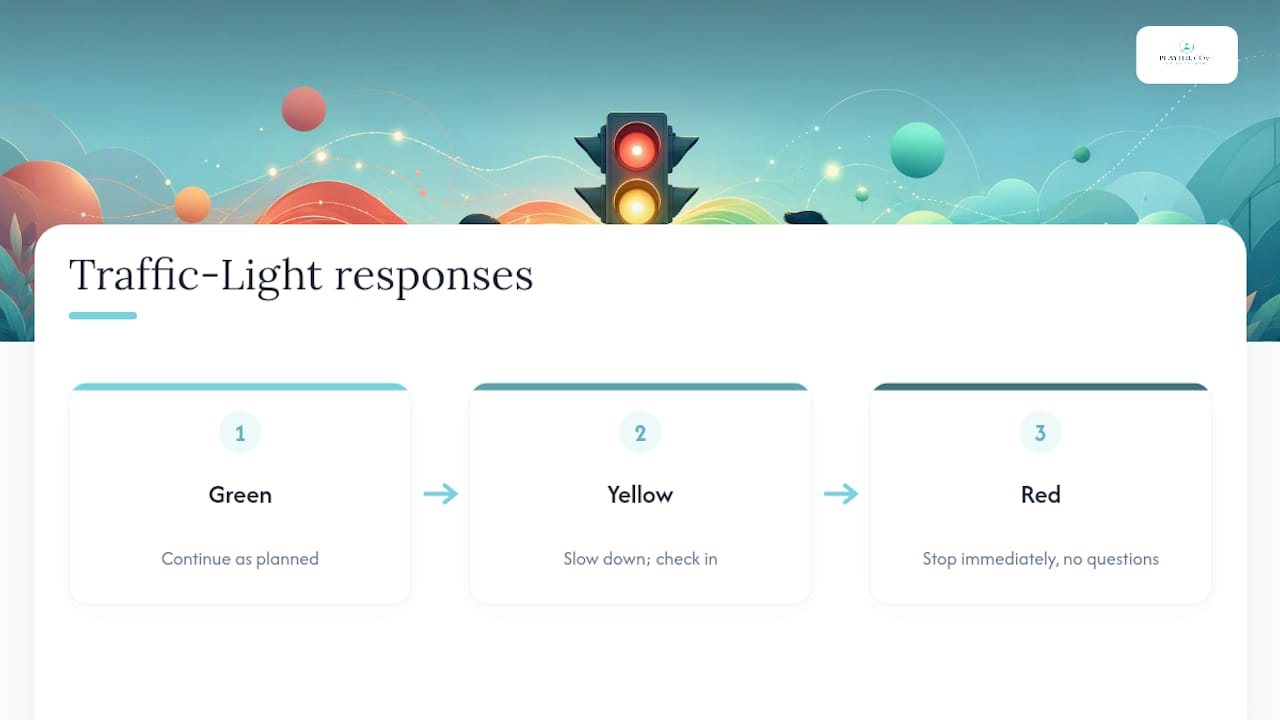
Yellow gives you room to say “ease up” without ending the entire encounter. That one addition is why the traffic-light convention has become the standard in kink communities: it’s short, unambiguous, and flexible enough for both scripted scenes and everyday intimacy.
A simple check-in like “Color?” asked mid-scene works well because it takes almost no effort to answer, even when someone is short of breath or deep in a headspace where forming full sentences feels hard. The traffic-light system tends to serve better than a single word specifically when a scene involves extended intensity, multiple activities, or a partner who’s still new to reading nonverbal cues. A single safeword still works fine for shorter, lower-intensity encounters where a clean stop is really the only signal you need.
How to Choose and Negotiate a Safe Word Before Play
The word only works if both people trust it completely, and that trust gets built before clothes come off, not during. A rushed “yeah, sure, whatever works” agreement is how safewords fail.
Run through this checklist together:
- Pick something distinct. Avoid words either of you might say naturally during sex or that sound similar to moans or common phrases.
- Make sure it’s easy to say under stress. Try it out loud, more than once, in a normal tone and a breathless one. If it’s hard to get out when you’re not aroused, it’ll be nearly impossible mid-scene.
- Agree on what it triggers. Does the word mean “stop everything right now,” or “pause and talk”? Decide this in advance so there’s zero ambiguity later.
- Set a nonverbal backup. Cover what happens if speech isn’t an option (more on that below).
- Plan aftercare before you need it. Decide who checks in, how, and what comfort looks like once the scene ends.
A short negotiation script can sound as simple as: “If I say ‘harbor,’ we stop completely. If I tap your arm three times because I can’t talk, that means the same thing. Afterward, I’d like us to just lie together for a few minutes.” This kind of direct, pre-scene conversation is exactly what college wellness programs and community safety tip sheets recommend before any scene involving heightened intensity or restraint.
Pro Tip: Practice your safeword in a completely non-sexual moment first, like while cooking dinner. Saying it out loud outside the heat of the moment makes it far easier to access when you actually need it.
If a partner ignores or argues against your safeword once it’s spoken, that’s not a small miscommunication. It’s a consent violation, and it’s worth treating it as seriously as it sounds.
Nonverbal Signals for When You Can’t Speak
Gags, breath play, and intense sensation can all make speaking difficult or impossible, which is exactly why a verbal-only plan has a gap in it. A reliable nonverbal system fills that gap.
Common signals that work well:
- Object drop: Hold something (a small ball, a scarf) and drop it to signal stop.
- Three taps: Tap your partner’s arm, leg, or the bed three times in quick succession.
- Hand squeeze pattern: One squeeze for “check in,” two for “stop now.”
- Bell or noisemaker: Keep something within reach that makes noise if hands are restrained.
Test the signal before the scene starts, not during it. Practice the exact motion, confirm your partner recognizes it instantly, and agree that any nonverbal signal carries the same authority as a spoken safeword, no debate, no pause to “make sure you mean it.”
Before using restraints or gags, run a quick safety check: confirm the nonverbal signal is physically possible given how someone is restrained, keep something like safety shears nearby, and never gag someone so thoroughly that a noisemaker or hand signal becomes their only option with no backup.
A Bigger Bank of Safe Words to Choose From
Sometimes you just want options. Below is a wider list, organized so you can scan for something that fits your style without overthinking it.
Colors and simple words:
- Crimson
- Amber
- Violet
- Indigo
- Turquoise
- Charcoal
Fruits and food:
- Papaya
- Kiwi
- Nectarine
- Cantaloupe
- Marmalade
- Tangerine
- Guava
Absurd or unexpected nouns:
- Kazoo
- Flamingo
- Waffle
- Igloo
- Trombone
- Sasquatch
- Pinecone
Multiword phrases (useful when a single word feels too easy to blur into dirty talk):
- “Yellow light, please”
- “Need a minute”
- “Full stop now”
- “Check in with me”
- “Pineapple express”
Emergency-only words (reserved strictly for hard stops):
- Mayday
- Code red
- Emergency stop
- Hard no
A short note on picking from a list like this: go with something culturally neutral and easy for both partners to pronounce without hesitation. Avoid inside jokes so specific that they take a beat to register, and skip anything tied to a painful memory or an ex. Clarity beats cleverness every time.
Whatever you land on, pick exactly one word (or one traffic-light setup) per relationship or scene type, and actually practice saying it out loud before you need it for real. A list is only useful once it’s been chosen and rehearsed, not just read.
Why Sex Therapists Say Safewords Matter
Certified sex therapist Shamyra Howard has explained that safewords give partners a nonjudgmental way to pause or stop, without needing to justify their feelings mid-scene. That framing matters: a safeword isn’t a sign that something went wrong. It’s a built-in off-ramp that protects both people.
Institutional resources back this up consistently. University wellness programs publish tip sheets recommending explicit negotiation and safewords as standard practice, not just for kink but for any sexual relationship. Community-written guides on kink safety echo the same core structure: agree first, signal clearly, respect the signal immediately, every time.
The editorial approach to this topic is safety-first, judgment-free, and grounded in what actual experts and institutions recommend, not guesswork.
Where Safewords Came From
Safewords as a formal concept trace back to organized kink and BDSM communities, where the traffic-light framework emerged as a practical solution to a real problem: role-play often involves saying “no” or “stop” as part of the fantasy itself. Communities needed a signal that couldn’t be confused with performance.
The traffic-light system caught on because it borrowed something everyone already understood instantly, a familiar visual and verbal cue with zero learning curve. Red means stop. Everyone gets that without a manual.
What’s changed more recently is who’s using the concept. Safewords have moved well outside dedicated kink circles and into mainstream conversations about sex and communication generally. Couples with no interest in role-play or restraints now use a single agreed word just to create a low-stakes way to pause during any sexual encounter. That shift makes sense: the core idea, that people should have an easy way to stop without a debate, applies to every relationship, not just ones involving props or scripts.
The word itself has always mattered less than the agreement behind it. Early kink communities didn’t succeed because they picked clever words. They succeeded because they treated the agreement as non-negotiable once it was made.
Why Using a Safe Word Actually Helps
A safeword does something more than stop a scene. It gives you permission to change your mind mid-experience without guilt, negotiation, or a breakdown of the mood. That permission is the whole point.
Without a pre-agreed signal, plenty of people push through discomfort rather than interrupt a partner or “ruin” the moment. That silence has real costs. Clinical resources on sexual health and consent point to predictable, negotiated signals as part of building genuine safety in intimate relationships, especially for people rebuilding trust after difficult experiences. A Johns Hopkins wellness resource on sexual pleasure after trauma similarly points to predictable signals as a way to rebuild a felt sense of safety during sex.
There’s a confidence benefit too, one that’s easy to underestimate. Knowing you have an exit that will be honored instantly, no argument, no hurt feelings required, tends to make people more willing to try new things, not less. Paradoxically, the safety net is often what makes exploration feel possible in the first place.
For couples, agreeing on a safeword together can also function as a small trust exercise on its own. The conversation itself, deciding what stop means, how you’ll signal it, what happens after, builds a habit of checking in that tends to carry over into other parts of the relationship. That’s a benefit that has nothing to do with kink specifically and everything to do with communication.
Mistakes and Misconceptions Worth Correcting
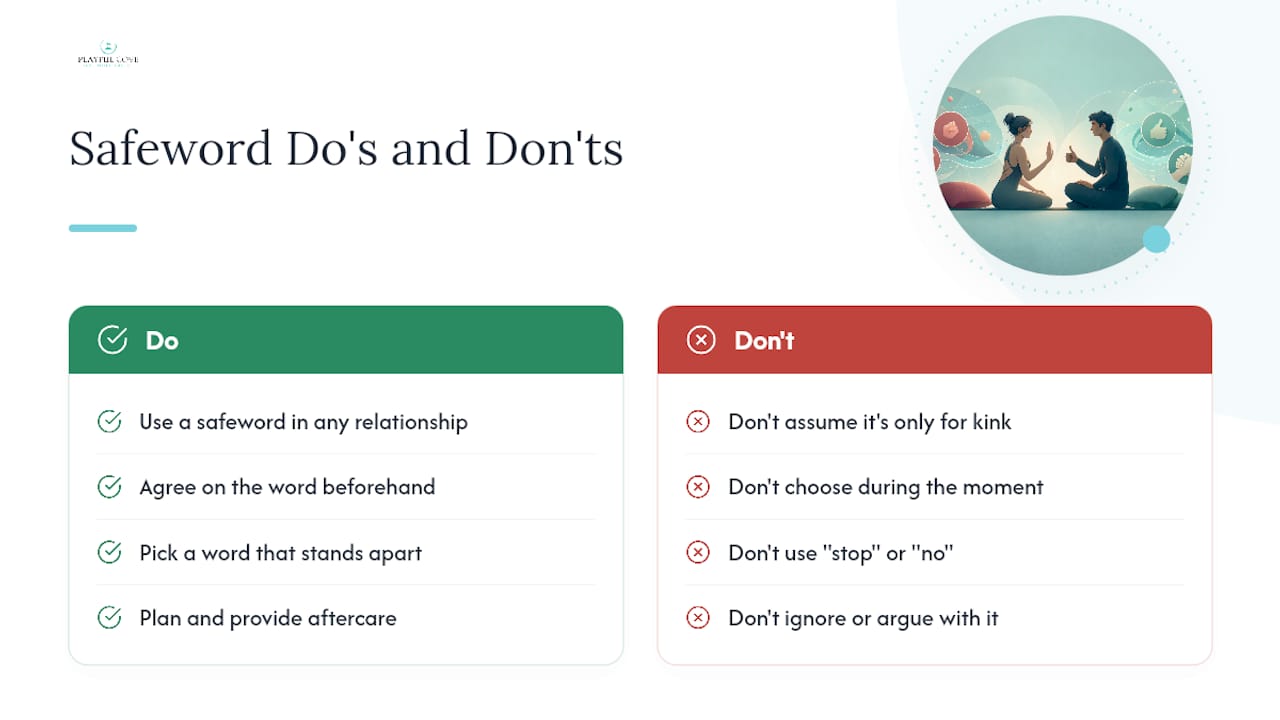
The biggest misconception: safewords are only for BDSM or kink. In practice, any couple can use one, and plenty of “vanilla” relationships benefit from a quick way to pause without a whole conversation. You don’t need restraints or role-play to want an easy exit signal.
Another common mistake is picking a word during the moment instead of beforehand. If you’re negotiating what a safeword even means while you’re already in a scene, it’s too late to be useful. The entire value comes from having it settled ahead of time.
A subtler error: choosing a word that’s too close to something you’d naturally say. “Stop” and “no” get used constantly in dirty talk and role-play, which strips them of urgency exactly when you need urgency most. Pick something that stands apart from your usual vocabulary during sex.
People also assume a safeword is a sign of a bad partner or a bad match. It’s the opposite. A partner who welcomes a safeword and honors it instantly, without sulking or pushing back, is showing you exactly how they’ll handle your boundaries elsewhere. And if a safeword ever gets ignored or argued with in the moment, that’s not a gray area. Community guidance on kink safety treats an ignored safeword as a serious violation that calls for stopping completely, having an honest conversation afterward, and rebuilding trust before any further play, not brushing past it.
Last mistake worth naming: skipping aftercare. Agreeing on a word and never discussing what happens after it’s used leaves a gap right when someone might need reassurance the most.
Why Playful Cove Publishes Guides Like This
We put resources like this together because good information should be easy to find and free of judgment. Sexual wellness content works best when it’s practical, not preachy, and when it treats readers as capable adults who just want clear answers.
Our commitment runs alongside that: private packaging, discreet shipping, and a shopping experience that never makes anyone feel like they need to explain themselves. If you’re building an aftercare routine to go with your safeword plan, our guide to body-safe massage oils is worth a look, and so is our roundup of comfort-focused gifts for couples.
Safety-first doesn’t mean sterile. It means giving people the tools to explore with confidence.
— Playful Cove Editorial Team
Simple Aftercare and Comfort Picks From Playful Cove
There are various products available that can help make the experience smoother and more comfortable, such as body-safe lubricants that reduce friction and discomfort during longer sessions, which can be especially useful when using safeword signals to slow things down and restart.

We carry the JO Classic Hybrid Personal Lubricant for couples who want a reliable, body-safe option on hand, along with the JO Premium Silicone Lubricant for longer scenes. If you’re exploring partnered play where a clear safeword and check-ins matter most, the My Secret Screaming O Premium Dual Vibe Remote and Egg Silicone Combo Kit is built for exactly that kind of shared, communicative experience. Every order ships in discreet packaging with no branding on the outside. Browse our lubricant and aftercare picks and add what fits your plan before your next scene.
Sources
- How To Have Safe Sex—Physically And Emotionally—Per Sex Experts
- Shamyra Howard — contact/biography (sex therapist)
- PMC article on sexual health / consent frameworks
- NCA safewords tip sheet (PDF)
