

Occasional oral use of most flavored lubricants carries low risk for healthy adults, but regular intravaginal use of many flavored formulas is not something we recommend at Playful Cove. The concern comes down to ingredients: certain sweeteners and humectants like glycerin and propylene glycol raise the fluid’s osmolality, which can irritate delicate vaginal tissue and throw off your natural balance of protective bacteria. The safer path is simple. Save flavored formulas for outercourse and oral play, and reach for glycerin-free, pH-balanced water-based or silicone lubricants when it’s time for vaginal contact.
TL;DR:
- Regular intravaginal use of flavored lubricants containing glycerin or propylene glycol can dehydrate vaginal tissue and disrupt the natural microbiome.
- Glycerin and propylene glycol raise the osmolality of lubricants, often into the thousands, increasing tissue irritation and bacterial suppression.
- Preservatives like chlorhexidine and nonoxynol-9 in flavored lubes can inhibit beneficial vaginal bacteria and may cause recurrent irritation.
- Store flavored lubes in a cool, dark place and replace them if their texture or smell changes, avoiding heat, light, and air exposure.
Table of Contents
- What Makes a Lube “Flavored,” and Why Does the Formula Matter?
- Which Ingredients in Flavored Lube Raise the Most Concern?
- Can Flavored Lube Disrupt Your Vaginal Microbiome?
- Is Flavored Lube Safe to Swallow During Oral Sex?
- How Do You Choose a Safer Flavored Lubricant?
- When Should You Skip Flavored Lube Entirely?
- How Should You Store Flavored Lube to Keep It Safe?
- What Certifications and Standards Should You Check For?
- Our Take: Why the Flavored Lube Conversation Needs More Nuance
- Playful Cove’s Picks for Body-Safe Flavored and Everyday Lubricants
- Sources
What Makes a Lube “Flavored,” and Why Does the Formula Matter?
Flavored lubricants start as a base, water, silicone, or a hybrid, and then get dressed up with taste and texture additives that standard lubes skip entirely. Manufacturers typically add nutritive sweeteners (sugar, sucralose, or fruit extracts), flavoring compounds, sometimes dyes, and occasionally warming or cooling agents like menthol or capsaicin derivatives for a tingly sensation.
Here’s the part most shoppers never think about: those sweeteners and flavorings usually ride in on a wave of humectants, glycerin and propylene glycol chief among them, that thicken the texture and help the flavor stick around. Those same humectants raise the product’s osmolality, the concentration of dissolved particles compared to your body’s own fluids. When a lubricant’s osmolality runs much higher than what’s inside your cells, water gets pulled out of those cells, leaving tissue dehydrated and more prone to microscopic damage, according to a review of osmolarity and epithelial effects in personal lubricants.
When you’re scanning a label, watch for:
- “Flavor” or “natural flavor” listed high up, which often signals a sugar-based carrier
- Glycerin, glycerol, or propylene glycol anywhere in the first five ingredients
- Vague terms like “warming blend” or “cooling sensation,” which usually mean menthol, capsaicin, or a proprietary irritant mix
- No pH or osmolality disclosure at all, which makes it hard to judge how the formula behaves against your body’s own chemistry
Which Ingredients in Flavored Lube Raise the Most Concern?
Not every additive in a flavored lubricant deserves the same level of caution, but a handful show up again and again in safety reviews and clinical guidance. Knowing them by name turns label reading from a guessing game into an actual filter.
The ingredients worth watching:
- Glycerin/glycerol – a humectant that raises osmolality and can dehydrate vaginal cells with regular use
- Propylene glycol – similar humectant effect, often paired with glycerin in flavored formulas
- Polyethylene glycols (PEGs) – thickening agents that can contribute to irritation in sensitive tissue
- Parabens – preservatives flagged in clinical guidance as a category to avoid for vulvovaginal products
- Chlorhexidine gluconate (CHG) – an antiseptic shown to strongly inhibit protective vaginal bacteria in lab testing
- Nonoxynol-9 (N-9) – a spermicide additive linked to the same bacterial inhibition and tissue irritation
- Nutritive sugars – sucrose, fructose, and similar sweeteners that can feed yeast overgrowth
- Fragrances and dyes – added purely for sensory appeal, with no functional safety benefit
- Warming/cooling agents – frequent irritant triggers for sensitive tissue
- Petroleum jelly or mineral oil – not designed for internal use and linked to higher infection rates when used that way
The World Health Organization’s procurement guidance for lubricants sets a practical benchmark here: water-based products should stay under 1,200 mOsm/kg, ideally much closer to the body’s own physiologic range. Glycerin and propylene glycol are two of the biggest drivers pushing a formula past that line.
The microbiome angle backs this up at the cellular level. Lab research testing personal lubricants against vaginal epithelial cells found that CHG and N-9 strongly suppressed Lactobacillus growth, the beneficial bacteria that keep your vaginal environment acidic and resistant to infection, and that several other lubricants reduced Lactobacillus colonization as well.
Osmolality in numbers: WHO guidance caps water-based lubricants at 1,200 mOsm/kg, but many flavored products on store shelves test in the thousands, largely due to their sugar and glycol content.
Pro Tip: If a product doesn’t list its osmolality (most don’t), treat a glycerin or propylene glycol listing near the top of the ingredient panel as your best proxy warning sign.
Can Flavored Lube Disrupt Your Vaginal Microbiome?
Your vaginal microbiome runs on a fairly simple system: Lactobacillus bacteria keep the environment acidic, and that acidity keeps yeast and unwanted bacteria in check. Disrupt that balance, and you open the door to bacterial vaginosis (BV) or a yeast infection, two of the most common complaints tied to irritating intimate products.
The evidence here is real but still developing. In vitro studies show certain preservatives and antiseptics reduce Lactobacillus viability under lab conditions, which is a meaningful red flag, but it’s not the same as a large, years-long human study tracking outcomes across thousands of people. Epidemiologic research adds a piece of that missing puzzle: a U.S. cohort found that intravaginal use of petroleum jelly and oils correlated with higher rates of BV and yeast infections, while lubricants actually designed for vaginal use didn’t show that same association in the same dataset.
That gap between lab findings and long-term human data is worth sitting with. It means the mechanism for harm is well understood, but the exact real-world frequency of problems from any one flavored product is still being mapped out.
Watch for these signs that a flavored lube isn’t agreeing with you:
- Burning or stinging that starts during or shortly after use
- New or unusual discharge, especially with an odor change
- Persistent itching that doesn’t resolve within a day
- Recurring irritation that shows up every time you use the same product
Any of those symptoms is your cue to stop the product and check in with a clinician, particularly if irritation repeats across more than one use.
Is Flavored Lube Safe to Swallow During Oral Sex?
“Edible” on a label is marketing language, not a food safety certification. It generally means the manufacturer expects small, incidental amounts to be swallowed during oral sex, not that you should treat the bottle like a snack. That distinction matters because occasional, small-quantity ingestion is a very different exposure than repeatedly swallowing large amounts.
For most healthy adults, occasional oral use of a lubricant marketed for that purpose is low risk. The bigger concerns are non-food-grade preservatives and heavy sugar content, both of which can matter more with frequent or large-volume use rather than a single encounter.
A few practical rules for oral use:
- Choose lubricants explicitly labeled safe for oral sex, not just “flavored”
- Rinse your mouth if you’ve swallowed a larger amount than usual
- Stop immediately if the taste triggers burning, tingling that doesn’t fade, or nausea
- Skip lubricants with sugar-heavy formulas if you’re prone to recurring yeast infections, since some sugar can transfer to vaginal tissue during transition between oral and vaginal contact
How Do You Choose a Safer Flavored Lubricant?
A body-safe checklist turns label reading into a five-minute decision instead of a guessing game. Run through these before you check out:
- Look for glycerin-free and paraben-free labeling. These two categories drive most of the irritation risk in flavored formulas.
- Skip nutritive sugar-based sweeteners if you’re prone to yeast infections; look for food-grade, non-nutritive alternatives instead.
- Avoid warming or cooling agents if you have any history of vulvovaginal sensitivity. They’re one of the most consistently flagged irritant categories in clinical lubricant guidance.
- Check condom and toy compatibility on the label. Oil-based formulas degrade latex condoms, and some flavored ingredients can also degrade certain silicone toy materials.
- Favor silicone-based or pH-balanced, glycerin-free water-based lubricants for anything intravaginal, especially if you have a history of infections. Our guide to lube for sensitive skin breaks down which formulas tend to work best for reactive tissue.
Beyond the checklist, a few usage habits go a long way. Patch test a new product on a small area of skin before full use. Reserve flavored formulas mainly for oral play and outercourse rather than making them your everyday vaginal lubricant. Rinse after oral use if you’re moving into vaginal contact next. And if you notice irritation, stop immediately rather than pushing through it.
Pro Tip: Keep one flavored lube for oral play and one glycerin-free water-based or silicone lube for everything else. Splitting the job between two products solves most of the ingredient conflict in one move.
When Should You Skip Flavored Lube Entirely?
Certain life stages and health conditions call for extra caution, since the same ingredients that are a mild annoyance for one person can be a bigger problem for another.
- Pregnant or trying to conceive: avoid glycerin, propylene glycol, N-9, and parabens. Most lubricants, flavored or not, can reduce sperm motility, and fertility-focused formulas use very specific pH and osmolality profiles for a reason. Our pregnancy-safe lubricant guide covers safer picks in detail.
- Perimenopause or menopause with vulvovaginal atrophy: thinner, more fragile tissue tolerates flavored additives poorly. Ask a clinician about pH-balanced, hyaluronic acid-based, or silicone alternatives instead.
- Recurrent BV, yeast infections, or painful intercourse: stop flavored lubes and see a clinician before reintroducing any scented or sweetened product. Preservative-free, fragrance-free options are usually the better starting point.
How Should You Store Flavored Lube to Keep It Safe?
Flavored lubricants degrade faster than plain water-based or silicone formulas because sugar-based sweeteners and flavor compounds are more chemically reactive over time. Heat, light, and air exposure all speed that process along, and a degraded lube doesn’t just taste off, it can also shift in pH and texture in ways that make it less predictable on sensitive tissue.
Store your bottle in a cool, dark place, a bedside drawer works better than a bathroom shelf, since bathroom humidity and temperature swings from hot showers accelerate breakdown. Keep the cap tightly closed between uses to limit air exposure, which slows both evaporation and any oxidation of flavor compounds.
Check the expiration date printed on the packaging, and treat it as a real deadline rather than a suggestion. Most flavored lubricants are rated for two to three years unopened, but that window shortens once the seal is broken. A good rule of thumb: if it’s been open longer than a year, or if you notice a change in color, smell, or consistency, replace it rather than risk using a product that’s shifted chemically.
Never store a flavored lube anywhere near direct sunlight or in a car during warm weather. Heat exposure breaks down preservatives faster than almost anything else, which can let bacteria grow in a product that was perfectly fine when you bought it.
What Certifications and Standards Should You Check For?
Regulatory oversight for personal lubricants is lighter than most people assume. In the United States, lubricants intended for internal use are typically regulated as medical devices, which means manufacturers must meet baseline safety and labeling requirements, but there’s no mandatory certification specifically for “body-safe” flavored formulas the way there is for, say, food-grade silicone.
That gap is exactly why international guidance fills in the blanks. The WHO’s procurement specifications for lubricants, originally written for global health programs, set a widely referenced benchmark: products should disclose ingredients, avoid unnecessary fragrance and color, and stay under the 1,200 mOsm/kg osmolality ceiling. Even though that document targets bulk procurement rather than individual consumers, it’s become a practical yardstick that clinicians and informed shoppers use to judge any lubricant, flavored or not.
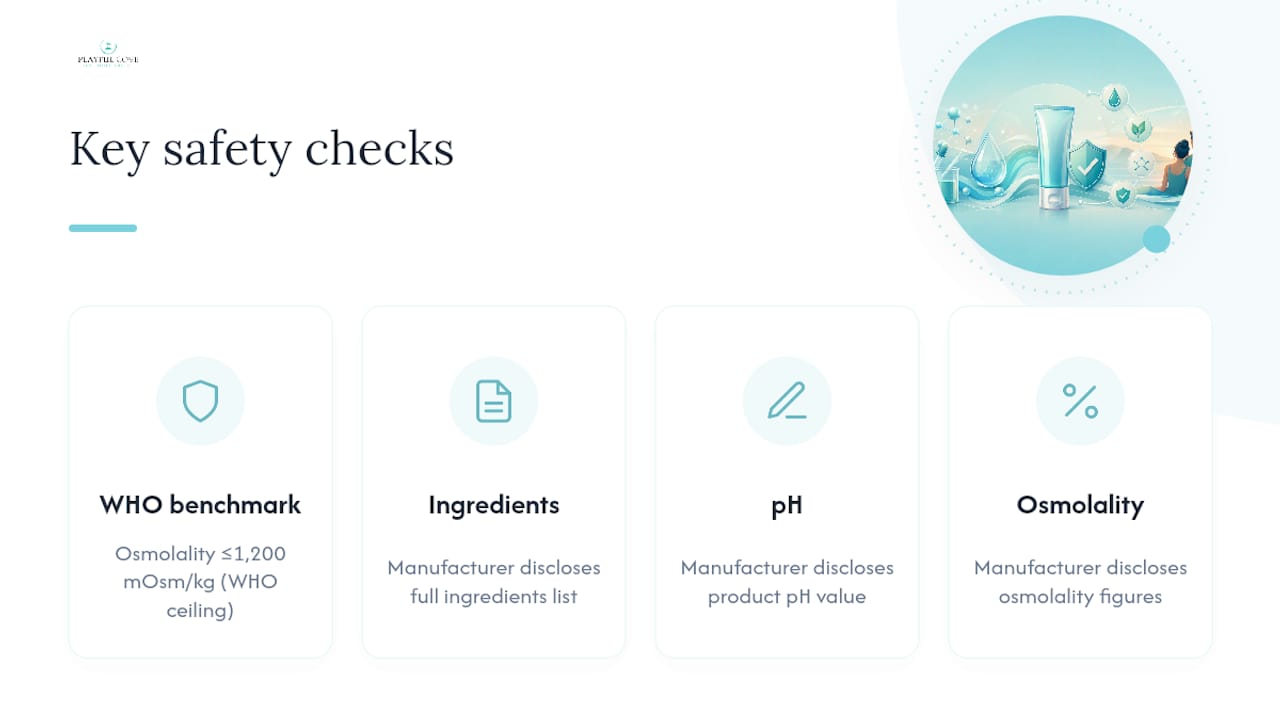
Look for manufacturers who voluntarily disclose pH and osmolality figures on their website or packaging insert. That level of transparency is still rare, but it’s the clearest signal a brand has actually tested its formula against biocompatibility standards rather than just meeting the legal minimum. When that information isn’t available, defaulting to the ingredient checklist covered earlier is your most reliable substitute.
Our Take: Why the Flavored Lube Conversation Needs More Nuance
Most advice on this topic swings to one extreme or the other. Either flavored lube gets treated as universally fine because it’s sold at every drugstore, or it gets treated as universally risky because a few ingredients sound alarming on paper. Neither extreme serves you well.
The real answer lives in the details: where you’re using it, how often, and which specific ingredients are in the bottle. A flavored lube with a clean, glycerin-free formula used occasionally for oral play is a very different risk profile than a sugar-heavy, glycerin-rich product used as an everyday vaginal lubricant. We think the ingredient-first approach, reading labels the way you’d read a food label, gives you far more control than trusting marketing language like “edible” or “natural” at face value.
At Playful Cove, we only stock and recommend lubricants that hold up against this same checklist, which means our picks reflect our own safety standards rather than a neutral survey of every product on the market.
— Playful Cove Editorial Team
Playful Cove’s Picks for Body-Safe Flavored and Everyday Lubricants
If you’ve made it this far, you already know the checklist: glycerin-free where possible, clear labeling, and condom compatibility you don’t have to guess about. That’s exactly what guided our lineup.
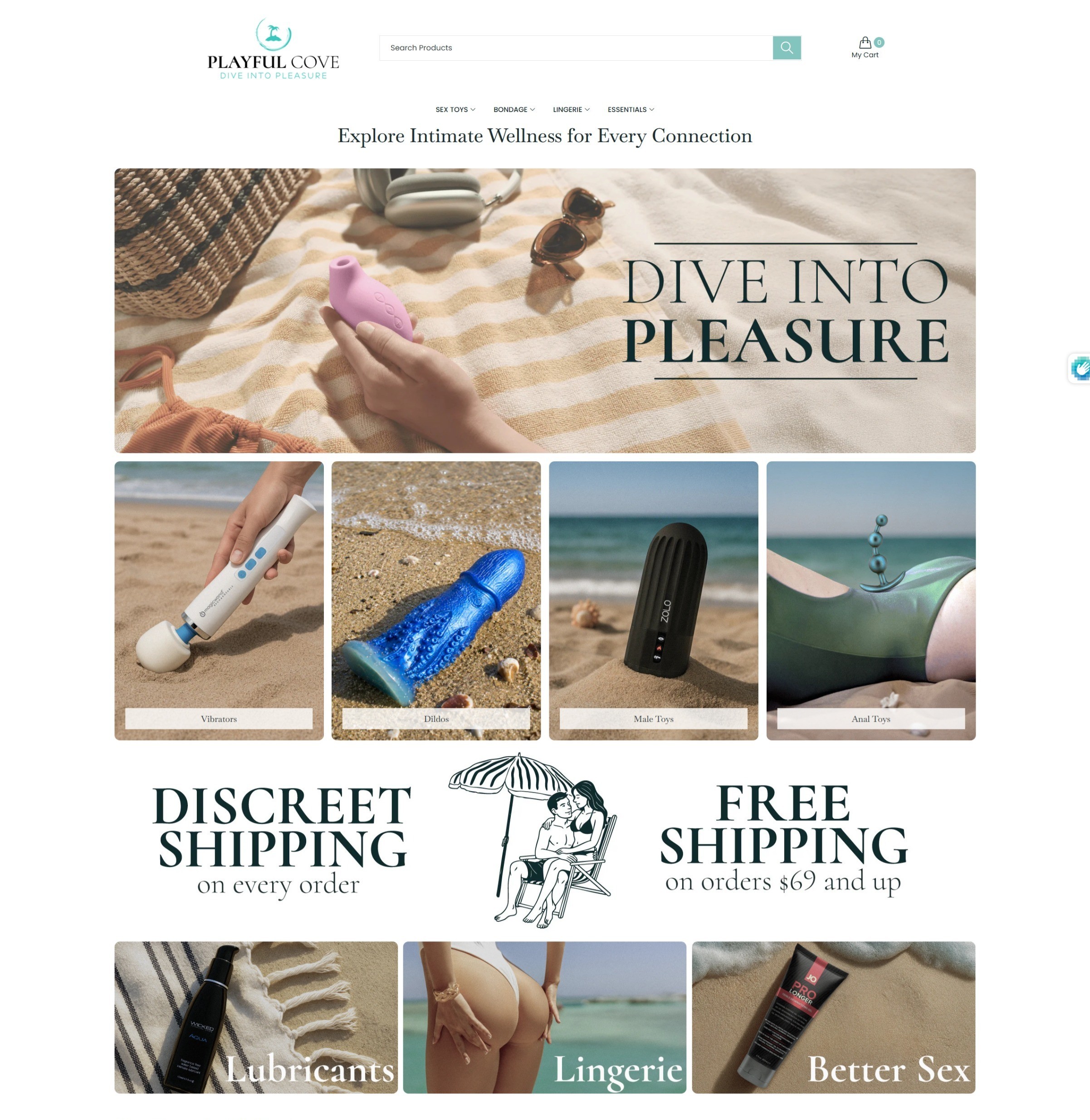
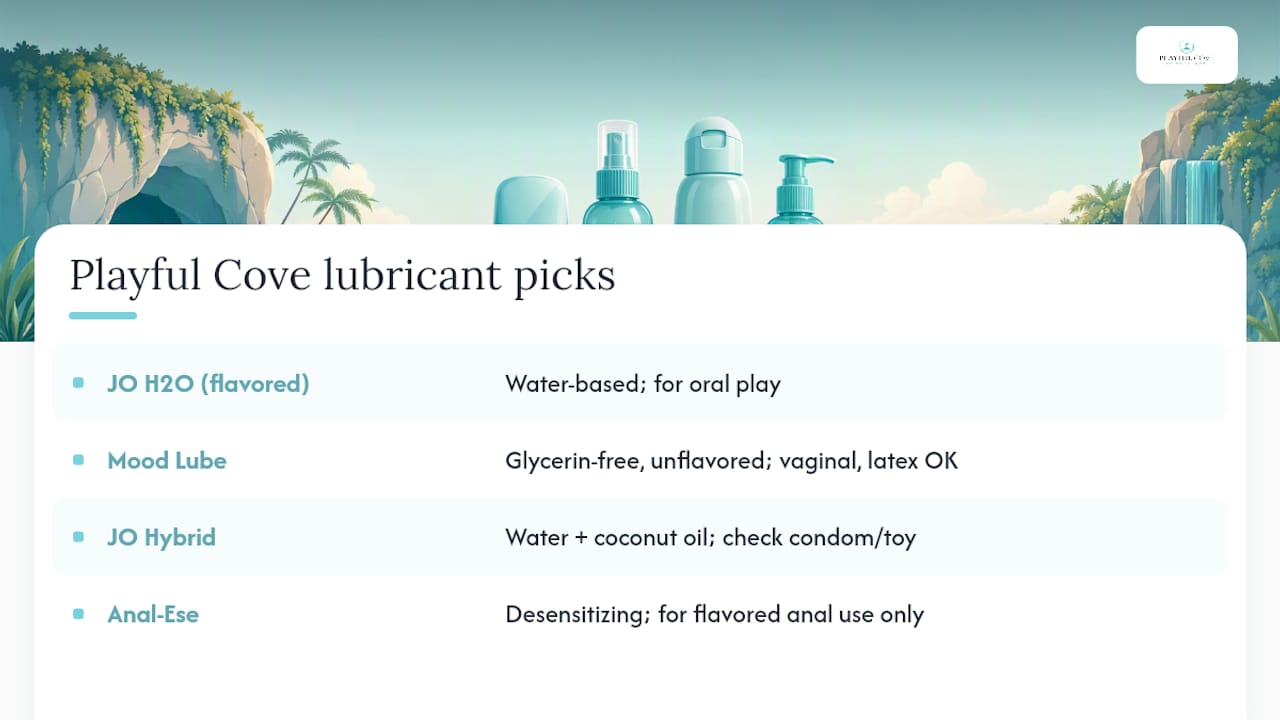
The JO H2O Water Based Flavored Lubricants are a solid starting point for oral play, offering flavor variety with formulas designed around water-based safety rather than an afterthought. For everyday vaginal use, the Mood Lube Water Based Lubricant is one of our most recommended glycerin-free, unflavored options, gentle enough for regular use and compatible with latex condoms. If you’re specifically shopping for a hybrid formula, the JO Silicone Free Hybrid Original Personal Lubricant blends water and coconut oil for a different texture profile, worth checking for toy and condom compatibility before use. And if flavored anal play is on your list, our Anal-Ese desensitizing lubricant is formulated specifically for that use case, not as a general-purpose vaginal or oral product.
Every product ships in discreet packaging with no branding on the outside, and our support team is happy to answer ingredient questions before you buy. Browse the full lubricant collection at Playful Cove to find the formula that matches your body and your comfort level.
This article is general information, not a substitute for advice from a qualified doctor. Consult a qualified healthcare professional about your own circumstances before acting on anything here.
Sources
- WHO guidance: procurement/specifications for personal lubricants (Annex 11, TRS 1025)
- Review on lubricant safety—osmolarity, epithelial effects, and product recommendations (PMC5977164)
- Approach to lubricant use for sexual activity | The College of Family Physicians of Canada
- Some popular vaginal products linked to infections, study finds (NBC News summary)
