

For most people with sensitive skin, the safest starting point is either a pH-balanced, glycerin-free water-based lubricant with a short ingredient list or a medical-grade silicone formula that omits fragrances, parabens, and warming agents entirely. Two products worth reaching for first: JO Premium Silicone Lubricant for long-lasting, low-allergen slip, and Intimate Earth Hydra Organic Water Based Glide Lubricant for a plant-based, minimal-ingredient option that plays well with condoms and toys.
Before you buy any lubricant, run through these quick label checks:
- No glycerin, propylene glycol, or PEG-8 — these glycols raise osmolality and can irritate sensitive tissue.
- No parabens or chlorhexidine — common preservatives linked to contact dermatitis.
- Fragrance-free and flavor-free — no exceptions for sensitive skin.
- No warming, tingling, or cooling agents — these are among the most common irritants.
- Condom and toy compatibility confirmed — silicone lubes are not safe with silicone toys; water-based options are universally compatible.
Table of Contents
- Why lube is genuinely good for sensitive skin
- What actually causes irritation in personal lubricants
- How each lube type performs for sensitive skin
- How to choose a lube for sensitive skin
- Recommended lubricants for sensitive skin
- How to safely test and use a new lubricant
- When to stop using a product and see a clinician
- What the research says about pH and osmolality
- Key Takeaways
- A note on choosing with confidence
- Shop sensitive-skin lubricants at Playful Cove
- Useful sources and further reading
Why lube is genuinely good for sensitive skin
Friction is the enemy of delicate tissue. Without adequate lubrication, even gentle sexual activity can create micro-tears in vaginal or anal mucosa, small breaks that raise infection risk and cause lasting soreness. A well-chosen lubricant reduces that friction, supports condom integrity, and makes longer sessions more comfortable without taxing sensitive skin.
Certain groups feel this benefit most clearly. People going through perimenopause or postmenopause often experience estrogen-related dryness that no amount of arousal fully compensates for. Medications like antihistamines, antidepressants, and hormonal contraceptives can reduce natural lubrication too. For anyone managing vulvar skin conditions such as lichen sclerosus, a gentle lubricant can be the difference between comfortable intimacy and days of recovery.
The immediate benefits are straightforward:
- Less pain and friction during sex
- Reduced risk of micro-tears that can allow bacteria or viruses to enter
- Better condom performance and less breakage risk
- Targeted relief for hormone- or medication-related dryness
What actually causes irritation in personal lubricants
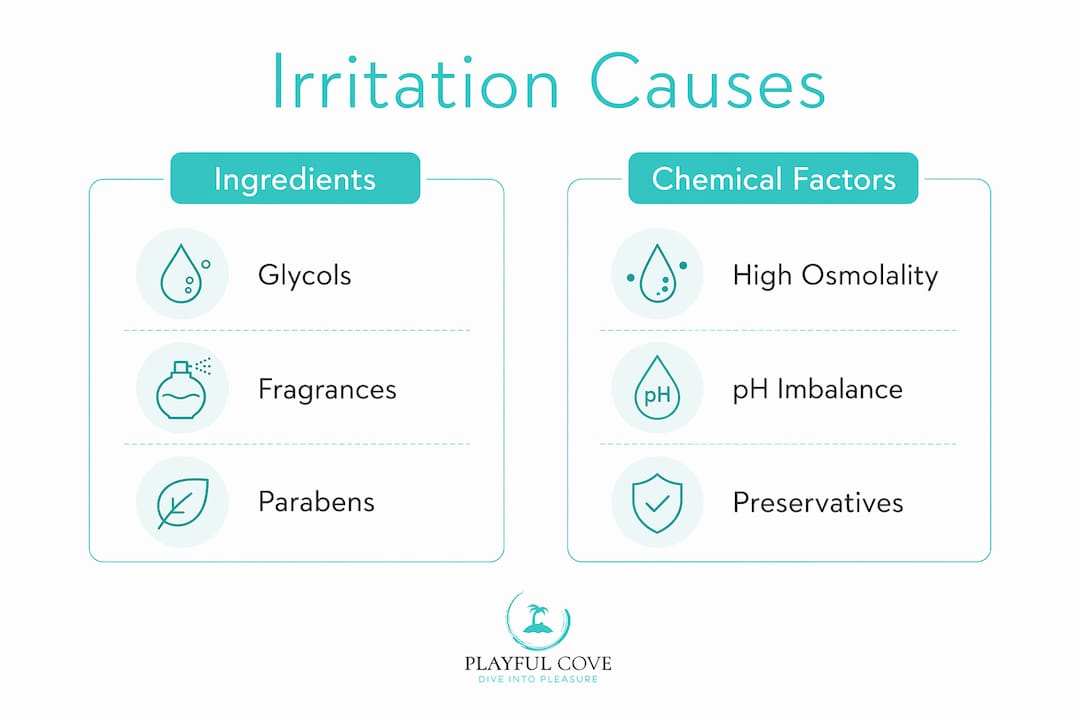
Most lube-related irritation does not come from one dramatic allergen. It comes from a combination of ingredients that disrupt the vaginal environment, draw moisture out of cells, or trigger a contact reaction on sensitive external skin.
Ingredients to avoid
Clinical guidance from the College of Family Physicians of Canada identifies these as the primary offenders:
- Glycerin — a humectant that feeds yeast and raises osmolality
- Propylene glycol — a common sensitizer and osmolality booster
- PEG-8 — another glycol with similar osmolality concerns
- Parabens — preservatives associated with contact dermatitis in sensitive individuals
- Chlorhexidine — an antiseptic that disrupts the vaginal microbiome
- Nonoxynol-9 (spermicide) — damages epithelial cells and increases STI risk with repeated use
- Fragrances and flavorings — among the most common contact allergens in personal care products
- Warming and tingling agents — capsaicin derivatives and menthol cause direct mucosal irritation
Aloe vera and hyaluronic acid are two ingredients that tend to go the other direction. Both are well-tolerated by sensitive tissue and can support hydration without disrupting pH, making them useful additions in gentle formulas.
The pH and osmolality problem
Key stat: A healthy vaginal pH is slightly acidic. Many commercial lubricants fall outside the ideal pH range, and some high-osmolality products can pull water out of epithelial cells, leaving tissue dehydrated and more vulnerable to infection.
Osmolality matters just as much as ingredients. Products with osmolality far above physiological levels stress mucosal cells even when the ingredient list looks clean. This is why a lubricant with “natural” marketing copy can still cause irritation if its formulation is hyperosmolar.
How each lube type performs for sensitive skin
Not all lubricant bases behave the same way on delicate tissue. Here is a practical comparison:
| Type | Best uses | Condom compatible | Silicone toy safe | Sensitive skin notes |
|---|---|---|---|---|
| Water-based | Vaginal, anal, toy use | Yes (latex and non-latex) | Yes | Safest ingredient profile; may need reapplication; avoid glycerin/glycol versions |
| Silicone-based | Vaginal, anal, long sessions, water play | Yes (latex and non-latex) | No (degrades silicone toys) | Fewer allergens than many water-based formulas; long-lasting; no reapplication needed |
| Oil-based | External massage, non-latex toy use | No (degrades latex) | Depends on toy material | Associated with higher BV and yeast risk internally; avoid for vaginal use |
| Hybrid (water + silicone) | General use, longer sessions | Yes | No (contains silicone) | Moderate longevity; check full ingredient list carefully |
Clinician summaries consistently recommend water-based or silicone-based formulas for anyone who uses condoms or deals with recurrent irritation. Oil-based options degrade latex and have been linked to microbiome disruption with regular internal use, so they are best reserved for external massage with non-latex toys.
Silicone lubes often feel like silk and tend to be well-tolerated by sensitive tissue, but they cannot touch silicone toys without breaking down the toy’s surface. Water-based options are the most versatile for toy users, though they dry faster and may need reapplication.
How to choose a lube for sensitive skin
Follow these steps before committing to any new product.
- Pull the full INCI ingredient list. If a brand does not publish it, that is a red flag. Ingredient transparency is a basic trust signal.
- Screen for banned ingredients. Cross-check against the list above: glycols, parabens, chlorhexidine, nonoxynol-9, fragrances, warming agents.
- Check pH and osmolality if available. Prefer products with pH balanced for vaginal use. If osmolality is listed, lower values are preferable for safety.
- Confirm compatibility. Latex condom users can use water-based or silicone. Silicone toy users need water-based only.
- Prefer short ingredient lists. A short, recognizable ingredient list is one of the most reliable practical heuristics for sensitive skin.
- Patch test before full use. Apply a pea-size amount to your inner forearm, wait 24 hours, and check for redness or itching before any internal use.
Pro Tip: When osmolality is not printed on the label, avoiding glycols (glycerin, propylene glycol, PEG-8) is a reliable proxy for keeping osmolality closer to physiological levels, according to College of Family Physicians of Canada guidance.
Recommended lubricants for sensitive skin
These four options are available through Playful Cove in the United States and cover the most common sensitive-skin needs. Patch test every new product, even from this list.
| Product | Best for | Base | Condom safe | Silicone toy safe | Key feature |
|---|---|---|---|---|---|
| JO Premium Silicone Lubricant | Long-lasting slip, severe dryness, condom users | Silicone | Yes | No | Medical-grade; low allergen profile; no reapplication |
| JO H2O (water-based, non-warming) | Toy users, easy cleanup, broad compatibility | Water | Yes | Yes | Choose non-warming, unflavored variant only |
| Intimate Earth Hydra Organic Water Based Glide | Plant-based preference, minimal ingredients | Water (plant cellulose) | Yes | Yes | Short INCI list; organic plant-cellulose base |
| Intimate Earth Ease Relaxing Anal Silicone Glide | Anal comfort, persistent dryness, long sessions | Silicone | Yes | No | Durable formula; reduces reapplication frequency |
JO Premium Silicone Lubricant is the strongest pick for anyone whose primary concern is ingredient sensitivity. A study of 50 lubricants published in the Dermatology Online Journal found that silicone-based lubricants were less likely to contain common allergens than many water-based formulas, with some silicone products testing allergen-free entirely.
JO H2O in its non-warming, unflavored form offers the broadest compatibility. It works with every toy material and every condom type. Just be deliberate about which variant you select — the warming and flavored versions contain agents that can irritate sensitive tissue.
Intimate Earth Hydra is the go-to for anyone who wants a plant-based formula with a short, readable ingredient list. Its natural plant-cellulose base keeps the formula gentle, and it pairs well with silicone toys.
Intimate Earth Ease is built for anal use, where longer-lasting lubrication matters most. Its silicone base means no silicone toys, but for users dealing with persistent dryness or discomfort, the reduced need for reapplication is a real comfort advantage.
How to safely test and use a new lubricant
Introducing a new product carefully protects sensitive skin from unnecessary reactions.
- Patch test first. Apply a small pea-size amount to your inner forearm. Wait 24 hours. If there is no redness, itching, or swelling, proceed.
- Do an external test before internal use. Apply a small amount to the external vulva or perianal skin. Wait another 24–48 hours for delayed reactions.
- Start with a small amount during activity. Use less than you think you need and add more as needed. Excess product is harder to assess for reactions.
- Check your toys and condoms first. Confirm silicone lube is not going near silicone toys. Confirm oil-based products are nowhere near latex.
- Clean up gently after use. Warm water is enough for most water-based products. Silicone lubes may need a mild, fragrance-free soap.
- Wait and reassess. Some reactions are delayed by 24–48 hours. Note any new itching, burning, or unusual discharge in the day after use.
Mild warmth from increased blood flow during arousal is normal. Burning, stinging, or swelling that starts during or immediately after use is not — stop and rinse with warm water.
When to stop using a product and see a clinician
Some reactions go beyond minor irritation and need professional attention.
Stop using the product immediately if you notice:
- Intense burning or stinging that does not ease within minutes of rinsing
- Swelling, blistering, or hives on or near the application site
- Unusual discharge with an offensive odor
- Urinary burning or increased urgency after use
- Fever or pelvic pain in the days following use
When you see a pelvic-health clinician or dermatologist, bring the product’s full ingredient list, note the timing of the reaction, and take photos of any visible skin changes if possible. That information helps narrow down whether the reaction is a contact allergy, an osmolality-related irritation, or a secondary infection.
Recurrent yeast infections or bacterial vaginosis after lube use often point to glycerin or glycol exposure. Switching to a glycerin-free, glycol-free formula resolves the pattern for many people, but a clinician can confirm the cause and rule out other factors.
What the research says about pH and osmolality
The science here is clear and practical. Vaginal tissue is healthiest at a pH of 3.8–4.5. Products that fall outside that range can disrupt the Lactobacillus-dominant microbiome that protects against infection.
Osmolality thresholds to know: WHO and clinical guidance recommend a target of ≤380 mOsm/kg for water-based lubricants, with an upper acceptable limit of 1,200 mOsm/kg. Many commercial products test far above both thresholds.
High osmolality is not just a number. It means the product draws water out of epithelial cells on contact, leaving tissue temporarily dehydrated and more permeable. College of Family Physicians of Canada guidance links this mechanism directly to increased irritation and infection risk.
Practical shopping rules when osmolality is not on the label:
- Avoid glycols (glycerin, propylene glycol, PEG-8) — they are the primary osmolality drivers in most water-based formulas
- Prefer products with aloe vera or hyaluronic acid as the main humectant
- Shorter ingredient lists generally mean fewer osmolality-boosting additives
- When in doubt, silicone-based formulas sidestep the osmolality issue entirely since they contain no water-soluble humectants
Key Takeaways
For sensitive skin, the clearest rule is this: choose a glycerin-free, fragrance-free, pH-balanced water-based or medical-grade silicone lubricant with a short, transparent ingredient list, and always patch test before full use.
| Point | Details |
|---|---|
| Avoid glycols and parabens | Glycerin, propylene glycol, PEG-8, and parabens are the most common irritants in commercial lubricants. |
| Target safe osmolality | Ideal water-based lubricants have low osmolality; avoid products with long glycol-heavy ingredient lists when osmolality is unknown. |
| Match base to use case | Silicone for long sessions and dryness; water-based for toy compatibility; never use oil-based with latex condoms. |
| Patch test every new product | Apply to inner forearm, wait 24 hours, then test externally before internal use. |
| Playful Cove’s curated picks | JO Premium Silicone Lubricant and Intimate Earth Hydra are available at Playful Cove for sensitive-skin shoppers across the United States. |
A note on choosing with confidence
At Playful Cove, we believe that finding the right lubricant should feel calm and supported, not confusing. Every product in our lubricant collection is chosen with ingredient quality and comfort in mind. We publish full product details so you can read ingredient lists before you buy, and our team is available to answer questions about formulas and compatibility. All orders ship in discreet packaging, so your privacy is protected from checkout to doorstep. We are here to be your safe cove for intimate wellness, without judgment and without guesswork on your part.
Shop sensitive-skin lubricants at Playful Cove
Sensitive skin deserves a lubricant chosen with real care, not marketing language.

Playful Cove carries the full range of gentle, clinician-aligned lubricants covered in this guide, including JO Premium Silicone Lubricant and the Intimate Earth Hydra and Ease formulas, all available with discreet U.S. shipping and private packaging. If you use toys alongside your lubricant, a lube applicator can help you apply product precisely and reduce mess on sensitive external skin. Have a question about which formula suits your specific needs? Reach out to our customer support team before you order. Browse the full lubricant selection at Playful Cove and find the formula that feels right for you.
Useful sources and further reading
- College of Family Physicians of Canada — Approach to lubricant use for sexual activity
- Dermatology Online Journal — Lubricant allergenicity study (eScholarship)
- Evvy — Lube ingredients to avoid for vaginal health
- Healthline — Your guide to lube for sex: types, how to use, and more
- Dr. Anna Cabeca — Ingredients to avoid in lube
- WHO — Use and procurement of additional lubricants for male and female condoms (iris.who.int)
This article is for general information only and is not a substitute for advice from a qualified healthcare provider. If you experience persistent irritation, recurrent infections, or other concerns, consult a pelvic-health clinician or dermatologist for guidance specific to your situation.
