

Aftercare is the intentional, negotiated period of physical and emotional support that follows a BDSM scene. Start now with these five immediate actions:
- Hydrate. Offer water or an electrolyte drink right away.
- Re-warm. Wrap your partner (or yourself) in a blanket or soft robe.
- Remove and assess. Take off all restraints, check circulation, and scan for injuries.
- Offer comfort on their terms. Cuddle, hold space, or give quiet privacy — whatever was agreed before the scene.
- Schedule a check-in. Plan a text or call within 24 hours to catch any delayed emotional dip.
Pro Tip: If anyone shows signs of uncontrolled bleeding, loss of consciousness, persistent numbness, or suicidal ideation, call 911 immediately. Those are medical emergencies, not aftercare situations.
Key Takeaways
Aftercare is mutual, pre-negotiated care that protects both partners’ physical and emotional wellbeing after a BDSM scene, and planning it before the scene is what makes it work.
| Point | Details |
|---|---|
| Start physical care first | Hydrate, re-warm, remove restraints, and check for injuries before emotional processing begins. |
| Negotiate before the scene | Agree on touch preferences, follow-up timing, and a specific check-in plan before play starts. |
| Both roles need care | Dom drop is as real as sub drop; tops need explicit reassurance and decompression time too. |
| Monitor for 48–72 hours | Delayed drop can arrive days after a scene; schedule at least one follow-up check-in. |
| Playful Cove supports your kit | Discreetly shipped massage oils, vibrators, and comfort items are ready to pack for any scene. |
Table of Contents
- What Is BDSM Aftercare and Why Does the Science Support It?
- How to Negotiate Aftercare Before a Scene
- Immediate Physical Aftercare: Step-by-Step Body Care
- Emotional Aftercare: What to Say and Do in the First Hour
- Aftercare for Dominants and Tops: Their Needs Matter Too
- How to Build an Aftercare Kit That’s Ready When You Need It
- Red Flags and When to Get Medical or Mental-Health Help
- Aftercare Essentials Are Already in Your Cove
- Sources
What Is BDSM Aftercare and Why Does the Science Support It?
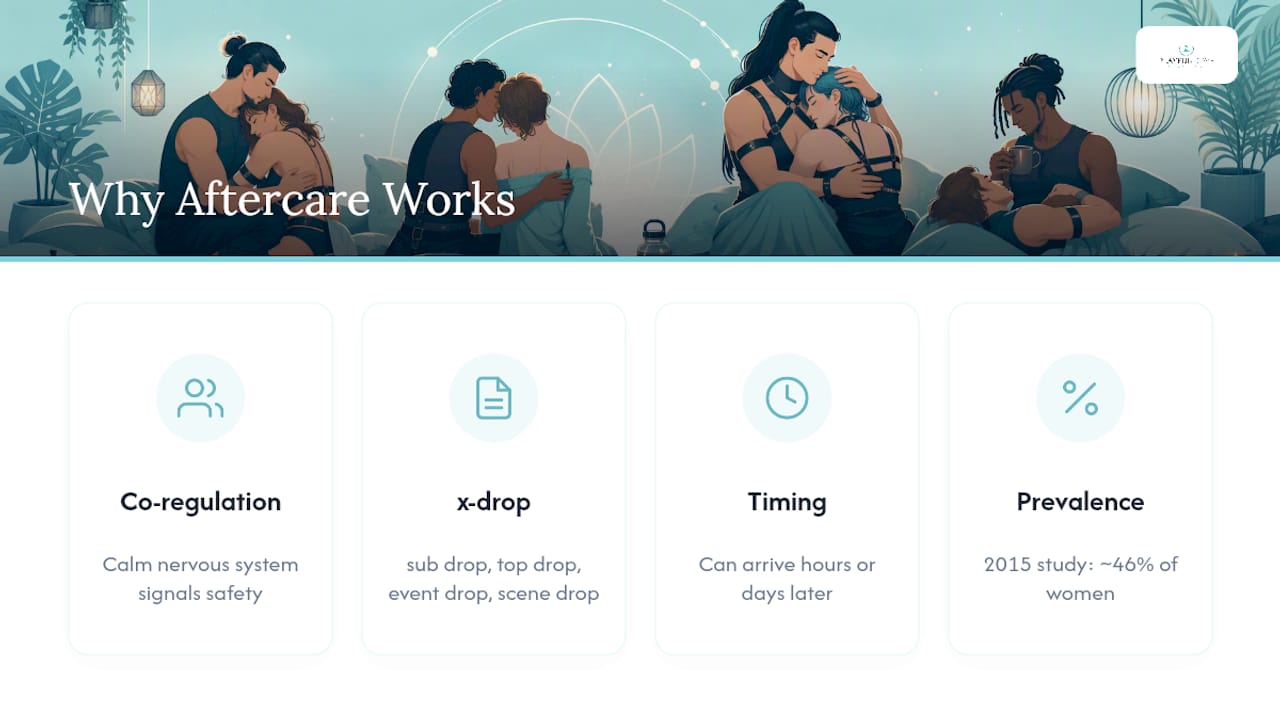
Aftercare works because it functions as a co-regulation sequence. When one person’s calm nervous system signals safety to another, both bodies shift from high activation back toward a grounded, social-engagement state. That is not a metaphor — it reflects how the autonomic nervous system responds after intense sexual or high-arousal experiences, including hormonal and physiological shifts that can leave participants feeling raw, tearful, or disconnected even when the scene itself was entirely positive.
The emotional dip that can follow intense play is commonly called “sub drop” or “dom drop,” and researchers have proposed an umbrella term, “x-drop,” to cover the full range: sub drop, top drop, event drop, and scene drop. Crucially, some drops are not immediate. They can arrive hours or even days after a scene, often resembling grief or identity-shift reactions rather than simple biochemical comedown.
A useful parallel from clinical research: a 2015 study of 230 participants found that roughly 46% of women had experienced postcoital dysphoria at least once. That figure reflects how common emotional vulnerability after intense sexual experiences really is, even when the experience itself was wanted and enjoyable.
Pro Tip: Both tops/doms and subs/bottoms can experience drop. Mutual aftercare is not a kindness — it is a shared need.
How to Negotiate Aftercare Before a Scene
The best aftercare is planned before anyone takes their clothes off. Improvising emotional support while both of you are coming down from an intense scene is harder than it sounds. A short pre-scene conversation removes that pressure entirely.
What to cover in your negotiation
- Preferred touch: Do you want to be held, or do you need space?
- Preferred distance: Is it okay to stay in the same room quietly, or do you need to be alone?
- First-aid needs and allergies: Any skin sensitivities, latex allergies, or existing injuries to flag?
- Timing and who initiates: Who calls the scene to a close, and who starts aftercare?
- Language to use or avoid: Some people find certain words grounding; others find them triggering post-scene.
- Follow-up schedule: A specific plan (“I’ll text you at 9 PM tonight”) reduces uncertainty-driven drop more reliably than a vague “check in later.”
Three script templates you can adapt
Minimal (quick check-in): “After we finish, I’d like about 10 minutes of quiet, then a glass of water and a hug. Can you text me tomorrow morning?”
Medium (standard scene): “I’d love to be held right after, then have some snacks together. Let’s avoid any heavy conversation for at least 30 minutes. Can we check in by phone the next morning?”
Detailed (intense or edge play): “Right after the scene, I need you to remove the restraints slowly, check my wrists, and bring me the blanket. I’d like 20 minutes of quiet cuddle time, then something light to eat. No debrief tonight — let’s talk tomorrow at noon. If I seem off, please text me at 8 PM regardless.”
Pre-scene agreement checklist
- Expected duration of aftercare (15 minutes? An hour?)
- Privacy boundaries (who else is in the space, or who might contact you?)
- Who will drive home if the scene is at a venue
- Emergency contact details for both partners
- Agreed follow-up window (24 hours minimum; 72 hours for intense scenes)
Immediate Physical Aftercare: Step-by-Step Body Care
Physical care comes first, before emotional processing. A dysregulated nervous system cannot absorb reassurance when the body still feels unsafe.
The primary sequence:
- Stop play safely. Use a safeword or a clear verbal close. Never rush this step.
- Remove all restrictive gear. Cuffs, rope, collars, and gags come off slowly and deliberately.
- Check circulation and injuries. Look at wrists, ankles, and any impact sites. Press gently to test sensation. Numbness that does not resolve within a few minutes needs medical attention.
- Move to a warm, soft space. Cold floors and hard surfaces extend physiological stress. A blanket, a robe, or a pile of pillows matters more than it sounds.
- Provide water and a light snack. CDC guidance on hydration supports replacing fluids after exertion or elevated heart rate. Electrolyte drinks are a smart addition after scenes involving significant physical intensity.
- Address bathroom and hygiene needs. Offer a warm washcloth, a trip to the bathroom, or a gentle wipe-down — whatever feels caring and practical.
Basic first aid for common minor issues
Rope marks and light bruising are common. Clean any broken skin with mild soap and water, not alcohol (which stings and can damage tissue). Apply a cold pack wrapped in cloth to fresh bruises. For impact sites, unscented lotion or aloe can soothe without irritation.

Escalate to urgent care or an ER if you see: wounds that won’t stop bleeding after 10 minutes of direct pressure, signs of a head injury (confusion, unequal pupils, vomiting), numbness that persists beyond 15 minutes, or any injury to the eyes or throat.
Pro Tip: Keep a small first-aid kit within arm’s reach of your play space — bandages, antiseptic wipes, cold pack, and unscented lotion. Pre-assembling it means you never have to search for supplies while someone is vulnerable.
Emotional Aftercare: What to Say and Do in the First Hour
Emotional aftercare starts with one simple principle: meet your partner where they are, not where you think they should be. Some people cry. Some go quiet. Some want to talk immediately. None of those responses are wrong.
High-impact actions for the first 10–30 minutes
- Give explicit reassurance. “You were amazing.” “I’m right here.” “You’re safe.” Short, specific, and sincere.
- Check in with a low-demand question. “Do you want water?” or “Shall I put on something quiet to watch?” are easier to answer than “How are you feeling?” when someone is still coming down.
- Give permission for their processing style. If they need silence, say: “I’m right here. You don’t have to talk.” If they want to debrief immediately, follow their lead.
- Avoid heavy decisions or problem-solving. The nervous system is not ready for logistics in the first 30 minutes.
Grounding techniques that work well post-scene
Slow, deep breathing together is one of the most effective tools available. The 4-7-8 pattern (inhale for 4 counts, hold for 7, exhale for 8) activates the parasympathetic system and can be done lying down under a blanket. Sensory soothing works too: a warm drink, soft music, or a low-stakes show in the background gives the mind something gentle to anchor to.
Tailoring emotional aftercare to scene type
Impact play: Expect a wider range of physical sensation and possible emotional flooding. Prioritize warmth and quiet physical presence before any words.
Humiliation play: Explicit verbal reaffirmation of the person’s worth and your genuine care is especially important here. The words used in scene need to be clearly separated from how you actually feel.
Bondage: Focus on the physical check first (circulation, skin), then move into emotional grounding. The transition from helplessness to autonomy can feel disorienting.
Pro Tip: Postpone the full debrief until both partners feel grounded — often the next day. A rushed debrief while still in drop can create misunderstandings that take longer to repair than the scene itself.
Aftercare for Dominants and Tops: Their Needs Matter Too
Dom drop is real, and it is underreported. Tops often feel guilt, emotional numbness, or a sudden crash in energy after a scene, even when everything went exactly as planned. These are neurochemical responses, not signs of moral failure or incompetence.
Common dom/top experiences after a scene
- Guilt or worry about whether the partner is truly okay
- Emotional flatness or numbness that arrives 1–2 hours after the scene
- Difficulty transitioning back to an everyday relational dynamic
- Feeling unseen or unacknowledged after focusing entirely on the partner
What partners can do to support a top
- Give a specific confirmation. “I’m okay. That was exactly what I wanted. Thank you.” That single sentence resolves more guilt-driven dom drop than almost anything else. Plan to say it before the scene ends.
- Offer short decompression time. A top who needs 15 minutes of quiet is not abandoning their partner. Build that into the aftercare plan.
- Send a follow-up message. A text the next morning that says “I feel good. Last night was wonderful” carries enormous weight for a top who spent the night second-guessing themselves.
Pro Tip: If you are a top practicing solo aftercare after a scene without a partner present, schedule a check-in with a trusted friend, write a brief journal entry, or use a grounding practice like a warm shower and a nourishing meal. Your care matters too.
How to Build an Aftercare Kit That’s Ready When You Need It
A pre-assembled kit removes decision-making from the most vulnerable moment. You do not want to be searching for a blanket or a bandage while someone is in drop.
Kit items by priority
Essential:
- Water bottle and electrolyte packets
- Light snacks (crackers, chocolate, fruit pouches)
- Soft blanket or robe
- Basic first-aid supplies (bandages, antiseptic wipes, cold pack, unscented lotion)
Comfort:
- Heat pack or hand warmers
- Lip balm
- Unscented massage oil for gentle, non-sexual touch
- Headphones and a calming playlist
Optional:
- Small journal and pen (for post-scene reflection)
- Phone charger
- A comfort object or small sentimental item
| Item | Priority | Notes |
|---|---|---|
| Water + electrolytes | Essential | Replace fluids after any physically intense scene |
| Snacks | Essential | Simple carbs help stabilize blood sugar quickly |
| Blanket or robe | Essential | Warmth supports nervous system regulation |
| First-aid basics | Essential | Bandages, wipes, cold pack, unscented lotion |
| Heat pack | Comfort | Especially useful for rope or bondage scenes |
| Massage oil | Comfort | Gentle touch without sexual expectation |
| Journal | Optional | Useful for processing delayed emotional responses |
| Phone charger | Optional | Needed for follow-up check-ins and emergency contacts |
Pro Tip: For travel or club play, pack essentials in a waterproof pouch inside a plain toiletry bag. Label it something neutral. Discreet storage means you are more likely to actually bring it.
Red Flags and When to Get Medical or Mental-Health Help
Some situations go beyond aftercare. Knowing the difference between a normal drop and a genuine emergency protects everyone.
Call 911 or go to the ER immediately for
- Uncontrolled bleeding that does not stop after 10 minutes of direct pressure
- Loss of consciousness, confusion, unequal pupils, or vomiting (signs of concussion)
- Persistent numbness or loss of sensation in hands, feet, or face
- Severe chest pain or difficulty breathing
- Any injury to the throat, eyes, or spine
- Suicidal ideation or statements of intent to self-harm
Signs that call for a kink-aware therapist
Prolonged guilt or shame lasting beyond several days, intrusive memories of the scene, emotional numbness that does not lift after 72 hours, or a drop that feels more like grief than a temporary dip — these are signals to seek support from a kink-competent mental health professional. The Sprott and Randall research on x-drop frames some later-onset drops as identity-change or grief responses, which respond better to therapeutic support than to standard aftercare practices.
When seeking care, bring: a brief description of the scene type (impact, bondage, etc.), a list of implements used if injuries are present, and photos of injuries only if safe and consensual to share. The Psychology Today therapist directory and the National Queer and Trans Therapists of Color Network both offer kink-aware filters.
A review of physiological responses after high-arousal events confirms that the body’s recovery timeline varies significantly between individuals, which is why monitoring for 48–72 hours after intense scenes is a reasonable standard.
A note on sustainable aftercare
The most common mistake in aftercare planning is treating it as a post-scene obligation rather than part of the scene design itself. When aftercare is negotiated in advance, practiced consistently, and extended to both partners, it stops feeling like a chore and starts feeling like what it actually is: a natural extension of the care and trust that made the scene possible in the first place.
Schedule aftercare the way you schedule the scene. Keep communication open for 72 hours after anything intense. And if you are a top who has been told “I’m fine, don’t worry about it” — ask again the next morning anyway. That follow-up is often where the real conversation happens.
Aftercare Essentials Are Already in Your Cove
Putting together a thoughtful aftercare kit does not require a trip to five different stores. Playful Cove carries the comfort and wellness items that belong in any well-prepared kit, from massage oils for gentle touch to rechargeable vibrators for sensory reconnection after a scene. Every order ships in discreet packaging with private billing, so your privacy is protected from checkout to doorstep.

Whether you are building your first aftercare kit or refreshing an existing one, browse Playful Cove’s full range of intimate wellness products at Playfulcove and find what fits your dynamic, your space, and your comfort level.
Sources
These primary sources back the safety and physiology claims in this guide. Each is worth bookmarking if you want deeper clinical or community context.
- PubMed: Schweitzer, O’Brien & Burri (2015) — postcoital dysphoria study
- PMC: Relevant review article on physiological responses after sexual activity or stress
- Black-and-Blues: Sub Drop, Top Drop, Event Drop and Scene Drop — Journal of Positive Sexuality (Sprott & Randall)
If red-flag criteria are met — uncontrolled bleeding, loss of consciousness, suicidal ideation, or drop that does not lift after 72 hours — contact emergency services (911) or a kink-aware mental health professional rather than relying on aftercare alone.
This article provides general wellness information and is not a substitute for professional medical or mental health advice. For emergencies, call 911. For ongoing mental health concerns, consult a qualified, kink-aware therapist.
