

The most useful way to pick a toy is by the experience you want, not the label on the box. Choose based on sensation and scenario: hands-free broad vibration, a discreet bulge under clothes, or partnered penetration. A lay-on wand, a strap-on-ready dildo, and a stroker cover most of that ground. Start with one toy and one bottle of lube or a storage pouch, and you already have a workable setup.
TL;DR:
- Choosing toys based on specific sensation and scenario ensures better satisfaction than relying on gendered labels or marketed categories.
- Focus on internal or external stimulation, vibration or pressure, solo or partnered use, and discreet or visible design when selecting a toy.
- Prioritize body-safe materials, waterproofing, noise levels, and seller guarantees to ensure safety, hygiene, and durability.
- Use a scenario-based approach to avoid unused toys and improve long-term value, especially by testing versatility and comfort first.
- Communicate openly with partners about boundaries and preferences before introducing toys to foster safer, more affirming experiences.
Table of Contents
- Why a Scenario-Based Sex Toy Shopping Framework Works Better
- Inclusive Toy Categories and What to Check Before You Buy
- Safety, Materials, and Hygiene for Toys That Get Real Use
- Making Toy Use Feel Gender-Affirming, Not Just Functional
- Playful Cove’s Approach to Inclusive, Scenario-Based Shopping
- Talking to a Partner Before Toys Enter the Room
- Accessibility and Adaptive Options for Different Bodies
- What Actually Matters When You’re Shopping (and What Doesn’t)
- Starter Picks for Scenario-Based Shopping at Playful Cove
- Sources
Why a Scenario-Based Sex Toy Shopping Framework Works Better
Sex toy packaging still leans hard on “his” and “hers,” but that framing tells you almost nothing about how a product actually feels or performs. A better question is: what experience do you want tonight? That single shift, from “which toy is for me” to “what do I want to happen,” reframes the entire shopping process for non-binary and gender-fluid users, and it works because sensation and mechanics don’t actually care what gender is printed on the box.
Start by breaking any scenario into four questions:
- Internal or external? Do you want stimulation on the outside of the body (clitoral, perineal, nipple) or inside (vaginal, anal)?
- Vibration or pressure? Do you want buzzing, pulsing sensation, or firmer thrusting and fullness?
- Solo or partnered? Will you use this alone, with one partner, or does it need to work in a harness for penetrative sex with someone else?
- Discreet or visible? Do you want something that reads as a bulge or presentation piece, or purely a private-use toy that never leaves a drawer?
Mapping those answers to categorize looks like this: someone who wants hands-free external buzzing and privacy might reach for a lay-on wand used under a towel or blanket. Someone who wants a visible bulge during the day might choose a soft packer that doubles as a discreet toy at night. Someone planning partnered penetration needs a harness-compatible dildo, not a wand at all.
The most effective shopping strategy for non-binary consumers is exactly this: prioritize intended stimulation and use-case over “for men” or “for women” categories. It also solves a real financial problem. A toy bought because it matched an assigned gender category, rather than a use-case you actually have, tends to sit in a drawer unused. A toy chosen for a specific scenario gets used repeatedly, which is the only real measure of whether a purchase was worth it.
Inclusive Toy Categories and What to Check Before You Buy
Once you know your scenario, the category almost picks itself. Here’s how to evaluate the main ones.
- Lay-on vibrators and wands. These work against the outside of the body, so they’re ideal when internal insertion isn’t the goal or isn’t wanted. Look at power output (multiple intensity levels matter more than raw motor strength), head size (broad heads diffuse sensation, narrower ones target it), and whether the design allows hands-free use tucked between the body and a mattress or partner.
- Strap-ons and harnesses. These are the category most people overthink. The dildo and the harness are usually sold separately, and fit depends on two things: the O-ring size sewn into the harness and the base diameter of the dildo. Retailers and reviewers consistently recommend checking harness O-ring size compatibility before buying, since a mismatched ring means the toy won’t seat securely. Adjustable straps and a flat, wide base matter more than length or girth for comfort during longer sessions.
- Strokers, sleeves, and packers. Strokers and sleeves are sized by internal diameter and texture, not by external appearance, so pick based on grip preference rather than assumed anatomy. Packers range from soft, purely cosmetic silicone to firmer designs meant to double as function during partnered play. Discreet coloring and a compact travel case matter if privacy is a priority.
- Pumps. Vacuum devices increase blood flow to genital tissue, producing temporary engorgement and heightened sensitivity, and devices with a built-in gauge allow more consistent, repeatable sessions than a manual pump with no pressure feedback. Any swelling from a pump session is temporary, and going slowly with pressure prevents bruising or discomfort.
Whatever category you land on, run the same four checks: material (medical-grade silicone over questionable blends), waterproofing (easier cleaning, more use cases), noise level (a factor if privacy or roommates matter), and the seller’s warranty or return policy on electronics.
Safety, Materials, and Hygiene for Toys That Get Real Use
Body-safe materials are non-negotiable, and this is one area where cutting corners genuinely costs you. Medical-grade silicone, stainless steel, and glass are all non-porous and safe for repeated use. Avoid “jelly” or unlabeled rubber blends, which are often porous, can harbor bacteria, and sometimes contain phthalates.
- Use only water-based or silicone-based lube with silicone toys; oil-based lube can degrade silicone over time.
- Wash silicone, glass, and steel toys with warm water and a dedicated toy cleaner or mild, unscented soap after every use.
- Use condoms on shared toys or when switching between partners or body openings, and change the condom between uses.
- For anal toys, always choose a flared base, start with a smaller size and work up gradually, and never go straight from anal to vaginal use without cleaning first.
A quick reality check: the CDC’s sexual health guidance treats basic hygiene, safer-sex practices, and knowing when to see a provider as core parts of sexual wellness, not optional extras. If you notice unusual irritation, discharge, or pain after toy use, that’s a sign to check in with a healthcare provider rather than wait it out.
Making Toy Use Feel Gender-Affirming, Not Just Functional
There’s no single toy that’s universally affirming. What eases dysphoria for one person might feel neutral or even uncomfortable for someone else, because affirming design depends entirely on the individual and the moment, not the toy category itself.
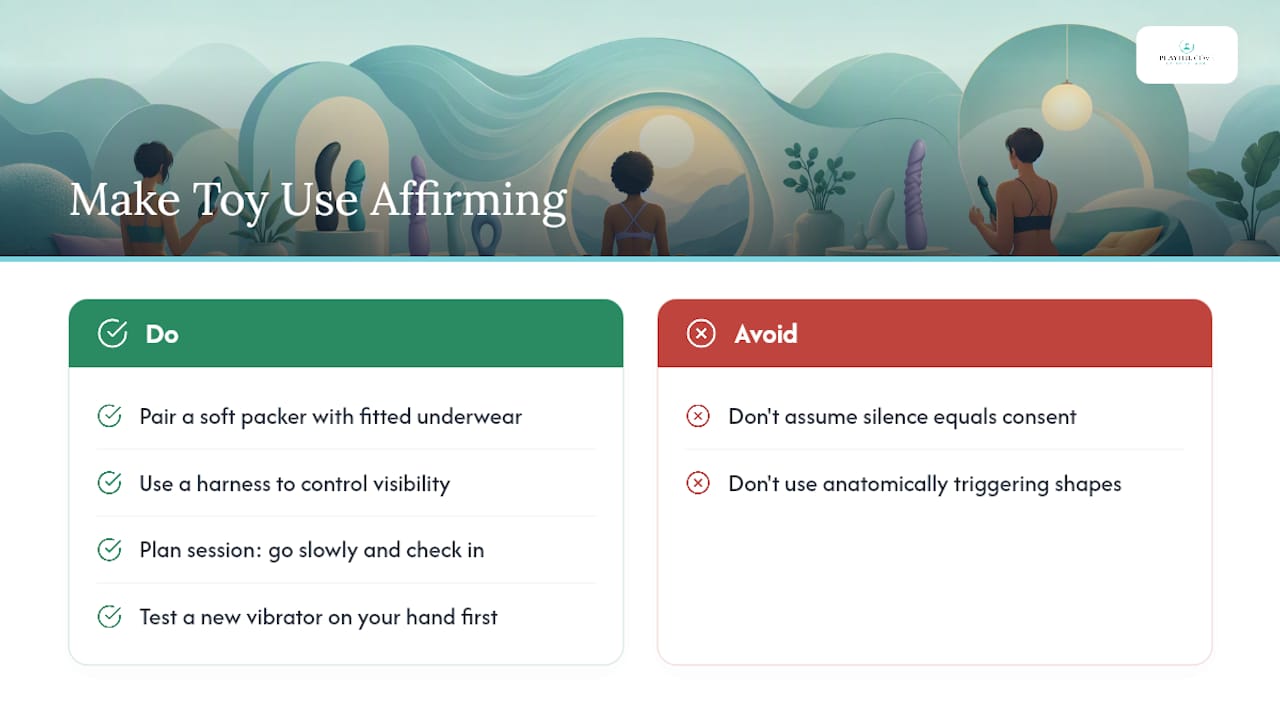
A few tactics come up again and again in reviews and community discussion. Pairing a soft packer with well-fitted underwear can create a comfortable, natural-feeling silhouette without exposure. Harness-and-dildo combinations let you control exactly how much is visible and how much is private, which matters if you’re presenting for the first time in a new context. Toys with non-anatomical shapes, like starfish-style lay-on vibes or wearable designs that don’t mimic typical genital forms, give some people a way to experience pleasure without the shape itself triggering dysphoria.
Session planning matters as much as the toy itself. Go slowly, agree on a stop signal or safe word before you start, and check in verbally during the session rather than assuming silence means everything is fine.
Pro Tip: Test any new vibrating toy against your hand or forearm before using it on your body. It takes the guesswork out of intensity levels and helps you figure out what you actually like before the pressure of a real session.
Storage matters more than people expect. A neutral, unbranded box or a dedicated drawer keeps toys out of sight from roommates or family and removes a small but real source of anxiety. When you’re ready to go deeper on specific categories, trans-led and queer-reviewed resources tend to offer more useful, lived-experience feedback than generic product listings.
Playful Cove’s Approach to Inclusive, Scenario-Based Shopping
The Playful Cove Editorial Team built this guide around one idea: shop for the experience, not the label. That means curating a catalog where filtering by function, whether that’s external stimulation, harness compatibility, or discreet wearability, matters more than gendered marketing copy.
A few practical filters worth using on the Playful Cove store:
- Filter by “vibration” versus “insertable” versus “wearable” rather than by category names that assume a gender.
- Check product descriptions for harness compatibility notes before buying a dildo intended for partnered use.
- Look for material listed explicitly as body-safe silicone, glass, or steel.
If you’re building out a broader toy collection, Playful Cove’s guides on choosing toys without gendered assumptions and powerful lay-on alternatives to a classic wand cover adjacent scenarios worth exploring next.
Talking to a Partner Before Toys Enter the Room
Consent conversations around toys work best when they happen before anyone is undressed, not in the middle of a session. Specificity helps more than general enthusiasm. “I want to try a strap-on with you” gives a partner much more to respond to than “I want to try new things,” and it opens space for them to say what they’re curious about or unsure of.
Bring up boundaries directly: which body parts are open for toy use, which aren’t, and what words or gestures mean “slow down” versus “stop completely.” If a toy involves a harness or presentation piece tied to gender expression, it’s worth naming that explicitly. A partner who understands that a toy is about affirmation as much as physical sensation will generally show up differently in the moment, more attentive, less likely to make assumptions about what a particular body part or toy “means.”
Revisit the conversation after the first try. What worked, what didn’t, and what you’d want to adjust next time are all fair questions to ask a day or two later, once the immediate moment has passed and you can talk about it without pressure. Consent isn’t a one-time checkbox before a new toy comes into play. It’s an ongoing conversation that shifts as your comfort, body, and preferences shift too, and treating it that way tends to make the whole experience feel safer for both people involved.
Accessibility and Adaptive Options for Different Bodies
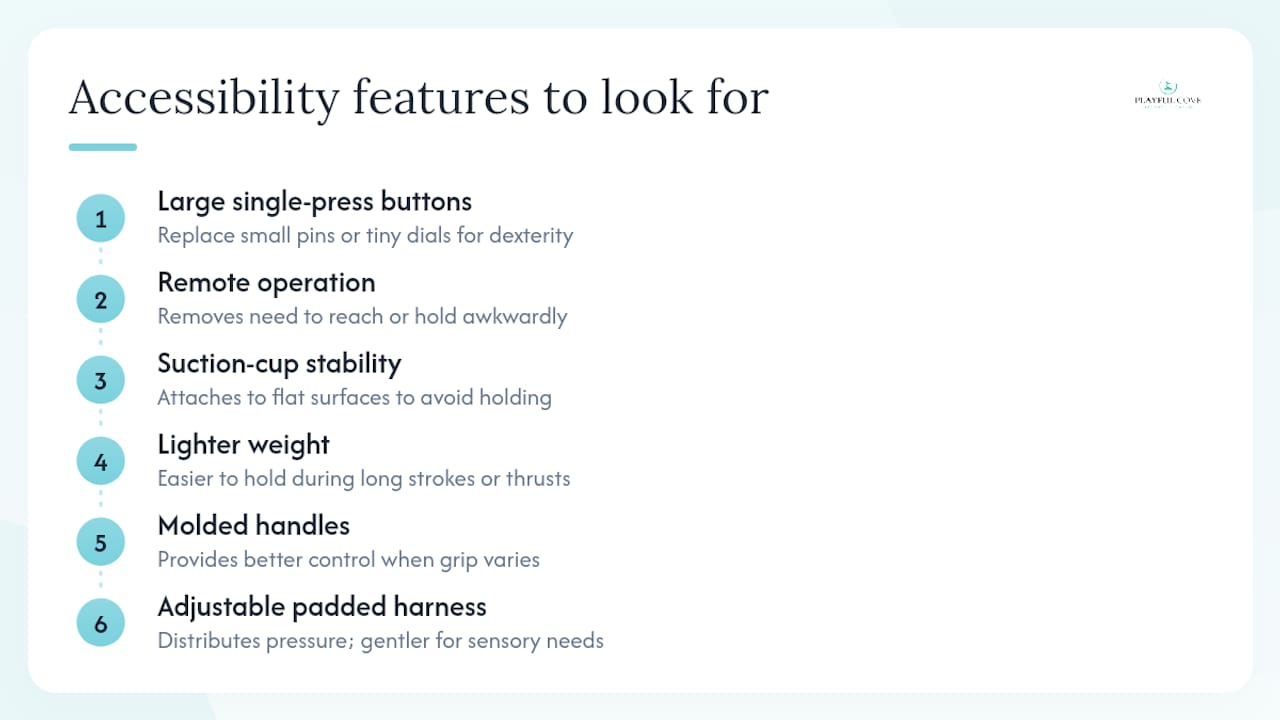
Standard toy design assumes a fairly narrow range of grip strength, mobility, and dexterity, which leaves a lot of people out. If a toy requires pinching a small button or twisting a tiny dial, that’s worth checking before buying if hand strength or fine motor control is a concern.
Look for toys with larger, single-press buttons instead of multi-function touch panels. Remote-controlled options remove the need to reach or hold a toy in an awkward position, which matters for anyone with limited mobility or chronic pain that flares with certain postures. Suction-cup bases let a toy attach to a flat surface, useful if holding a toy steady for an extended session is physically tiring.
Weight matters more than most people expect. A dense glass or steel toy can be difficult to hold for a long stroke or thrusting motion if grip strength varies day to day, while a lighter silicone toy with a molded handle is easier to control. Harness design matters too: adjustable, padded straps distribute pressure better than thin elastic, which matters for anyone using a harness for extended periods or with sensory sensitivities to certain fabrics.
None of this requires buying specialty “adaptive” branded products, which are often marked up and harder to find. It just means reading product descriptions with these questions in mind and reaching out to a retailer directly if a spec isn’t listed.
What Actually Matters When You’re Shopping (and What Doesn’t)
Most advice about non-binary pleasure products spends too much time on categorization and not enough on function. The industry has gotten better at dropping “his and hers” labeling, but that cosmetic fix doesn’t solve the harder problem: figuring out what sensation, presentation, or scenario you’re actually after.
The research on this is consistent. Reviewers and retailers who work directly with trans and non-binary customers point to the same conclusion over and over: flexible, non-anatomical shapes and low-profile designs tend to serve people better than toys built to mimic a specific anatomy. That’s a more useful starting point than any gender label ever was.
Where conventional advice falls short is treating “gender-affirming” as a fixed product category instead of a moving target that shifts with mood, context, and partner. Our take: buy for the scenario in front of you, not the identity label you’re supposed to fit into. Start with one versatile toy, test it honestly, and let your next purchase respond to what you actually learned, not what the packaging promised.
— Playful Cove Editorial Team
Starter Picks for Scenario-Based Shopping at Playful Cove
Once you know your scenario, Playful Cove carries specific options that map directly onto the categories covered above. If your priority is broad, hands-free external stimulation, the Mystique Vibrating Massagers Rechargeable Silicone Vibrator works as a lay-on option without requiring insertion. For partnered penetration with harness compatibility, the Naked Addiction Silicone Rechargeable Thrusting, Vibrating, and Rotating Dildo covers multiple sensation types in one toy, which reduces the guesswork of buying separate pieces.
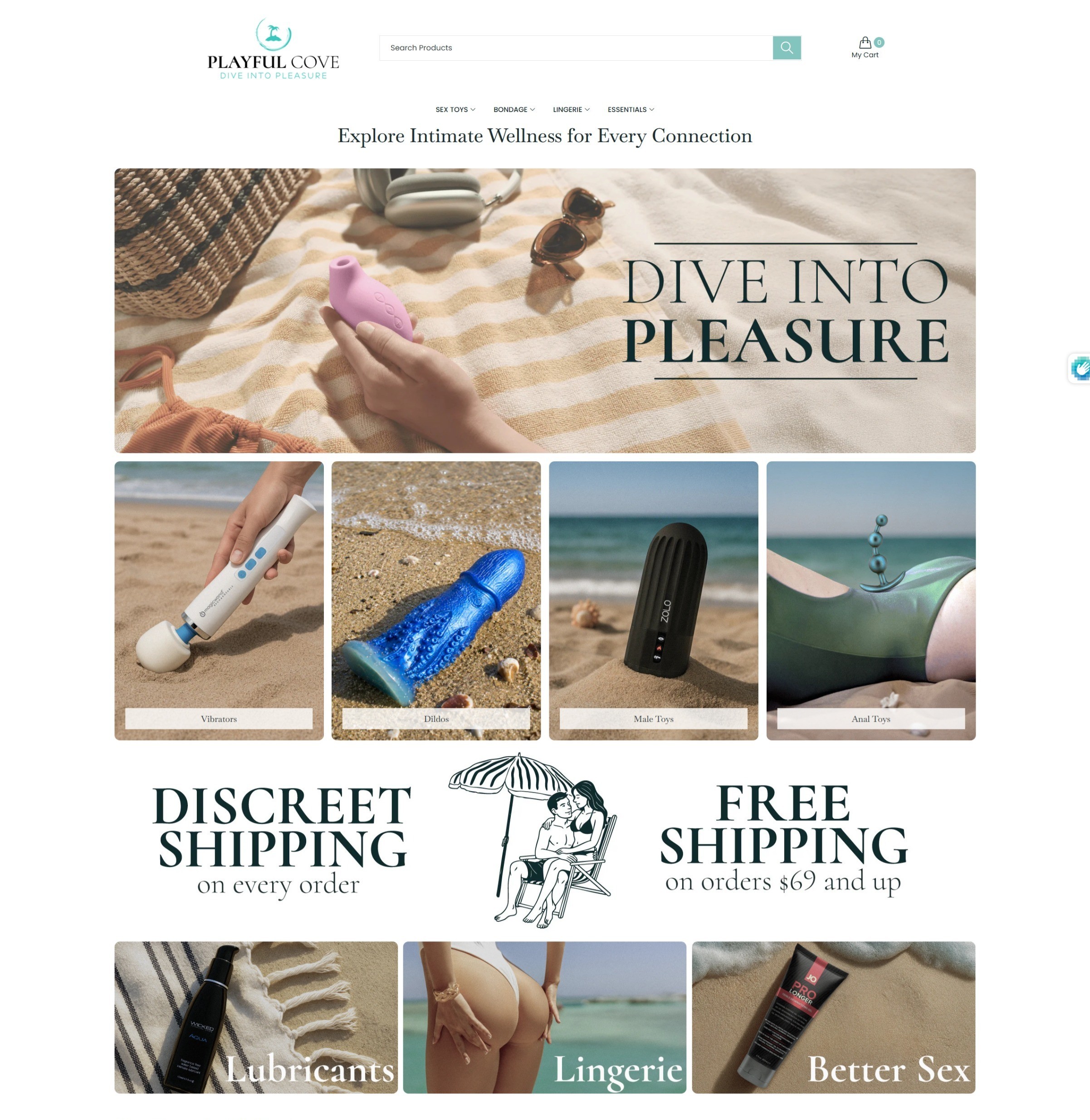
If solo stimulation or a discreet stroker is more your scenario, the Dynamo Rechargeable Dual End Vibrating Masturbator Cup offers two use styles in one compact design. And no matter which toy you start with, pair it with JO Classic Hybrid Personal Lubricant to protect both comfort and toy material.
Every order ships in discreet, unmarked packaging, and the return policy takes the pressure off a first purchase, so a toy that doesn’t turn out to fit your scenario isn’t a wasted decision. Browse the full collection at Playful Cove and filter by function rather than category to find the next piece that fits what you’re actually looking for.
Sources
- A Guide to the Evolving World of Gender Neutral Sex Toys - InsideHook
- Best gender-affirming sex toys for trans and non-binary people - Cosmopolitan (source highlights)
