

Yes, personal lubricants can and do expire or degrade over time. Check the printed expiration date or the PAO (Period After Opening) symbol first, then trust your senses. If the lube smells sour, has changed color, or feels grainy or separated, toss it, even if the date looks fine.
Three things to do right now:
- Find the date: Look for a printed expiry or an open jar icon marked “6M,” “12M,” or “24M.”
- Do a sensory check: Sniff, look, and feel for anything off before your next use.
- Fix your storage: Keep lube somewhere cool and dry, at a stable room temperature, away from bathrooms, cars, and windowsills.
Key Takeaways
Lubricants degrade through preservative breakdown, temperature cycling, and contamination, and storing them cool, dry, and dark within the PAO window is the single most effective way to keep them safe and usable.
| Point | Details |
|---|---|
| Check both dates | Printed expiry covers unopened storage; the PAO symbol governs how long a bottle lasts once opened. |
| Store at 59 to 77°F | Keep lube in a stable, dry, dark spot like a drawer, never a bathroom, car, or windowsill. |
| Trust your senses | Discard any lube with an off smell, color change, separation, or grainy texture. |
| Avoid nozzle contact | Use pumps or single-use applicators instead of double-dipping to protect the formula. |
| Buy what you’ll finish | Playful Cove’s water-based options, like the Mood Lube Water Based Lubricant, come in sizes suited to typical PAO windows. |
Table of Contents
- Why Lubricants Age: Ingredients, Preservatives, and Environment
- How Long Does Lube Last, Unopened Versus Opened?
- Storage Best Practices That Actually Extend Shelf Life
- Handling Habits That Quietly Shorten Shelf Life
- Signs Your Lube Has Gone Bad (and What to Do About It)
- Playful Cove’s Simple Rules for Everyday Lube Care
- Disposal, Replacement, and Smarter Shopping Going Forward
- What Most Advice Gets Wrong About Lube Shelf Life
- Fresh Lube and Applicators That Make Storage Easier
- Sources
Why Lubricants Age: Ingredients, Preservatives, and Environment
Most water-based lubes rely on a delicate balance between water content and preservatives to stay stable. That balance is fragile. Once heat, humidity, or light enter the picture, the preservative system starts breaking down faster than the label promises.
Temperature swings do more damage than steady warmth. A bottle that goes from a warm car to an air-conditioned bedroom and back again stresses the emulsion every single cycle, which is harder on the formula than one long stretch in a warm drawer. Storing lube in a cool, dry, dark place between 59°F and 77°F protects that emulsion and slows preservative breakdown.
Contamination is the other silent threat. Every time a nozzle touches skin, a toy, or a hand, it introduces bacteria and oils that no preservative was designed to fight off indefinitely.
- Humidity swells packaging seals and invites moisture into the bottle.
- Direct sunlight breaks down preservatives through UV exposure.
- Repeated nozzle contact bypasses the product’s built-in defenses entirely.
Pro Tip: Store lube in a drawer, not a bathroom cabinet. Bathroom humidity from showers is one of the fastest ways to shorten a bottle’s usable life.
How Long Does Lube Last, Unopened Versus Opened?
Shelf life depends heavily on formula, and the difference between an unopened bottle and one you’ve already cracked open is bigger than most people assume.
Unopened, most lubricants last about one to three years, though the exact window depends on the base ingredient:
- Water-based: typically 1 to 3 years unopened, the most common and most preservative-dependent type.
- Silicone-based: also 1 to 3 years, but chemically more stable since silicone doesn’t support bacterial growth the way water does.
- Oil-based: can run 3 to 5 years unopened, thanks to fewer water-reliant preservatives.
- Flavored or edible: often just 1 to 2 years, since food-grade sweeteners and flavorings break down faster than standard formulas.
Once opened, the clock resets. Guidance commonly points to using the product within 6 to 12 months after opening, but the real answer is printed right on the bottle. Look for a small open jar icon with a number inside, something like “12M.” That PAO symbol overrides any general rule of thumb once air, light, and your hands enter the picture.
Storage Best Practices That Actually Extend Shelf Life
Where you keep lube matters as much as what’s in the bottle. Follow these steps in order of impact:
- Pick a stable spot. A bedside drawer or closet shelf holds a steady temperature far better than a bathroom vanity, which swings with every hot shower.
- Keep it dry and dark. Humidity and light are preservative killers. A closed drawer beats an open shelf every time.
- Never store it in a car. Cars swing from freezing to over 100°F depending on the season, and that kind of temperature cycling stresses the formula faster than steady heat ever would.
- Close the cap fully after every use. An open or loose cap lets air and moisture creep in, even between uses just minutes apart.
- Mark the opening date. Write it directly on the bottle with a permanent marker the day you first use it, so you’re never guessing where you stand against the PAO window.
- Separate oil-based lubes from latex products. Oil breaks down latex condoms, so store these away from your condom stash to avoid an accidental mix-up mid-drawer.
Pro Tip: A small lidded box works better than a loose drawer. It blocks light completely and keeps bottles from rolling around and cracking their caps.
Consistency beats perfection here. A lube that lives in one cool, dark spot will outlast one that bounces between a nightstand, a gym bag, and a car console, even if both bottles are the same age.
Handling Habits That Quietly Shorten Shelf Life
Double-dipping, dipping a finger back into the bottle after it’s touched skin, is one of the fastest ways to contaminate an otherwise good product. It introduces bacteria and natural oils directly into a formula that has no way to fight them off long term. Touching the nozzle to skin or a toy does the same thing on a smaller scale, every single time.
Better habits are simple to build:
- Use a pump dispenser when your bottle has one, so nothing but product exits the container.
- Pour a small amount onto a clean hand instead of touching the nozzle to skin.
- Reach for a single-use applicator, like the Lube Tube applicator, for shared or less frequent use.
- Wash your hands before opening the bottle, not just after.
One more thing worth knowing: don’t store silicone lube touching silicone toys directly. The two materials can react and degrade each other over time, so keep them in separate spots even in the same drawer.
Signs Your Lube Has Gone Bad (and What to Do About It)
Your senses are the most reliable test you have, more reliable than the calendar in some cases. Watch for a sour or unusual smell, any color shift, separation, or a texture that’s turned grainy or sticky instead of smooth. Any one of these is reason enough to stop and replace the bottle.
- Sour, rancid, or chemical smell that wasn’t there before.
- Color that’s darkened, yellowed, or otherwise shifted from the original.
- Visible separation, clumping, or an oily layer on top.
- Texture that feels sticky, grainy, or thinner than usual.
If you’ve already used a lube that turned out to be past its prime and you feel stinging, itching, or burning, stop use immediately and rinse the area with water. Gynecologists advise against using lubricant once it’s expired or shows any of these changes, since degraded preservatives may raise the chance of irritation even when the risk isn’t fully mapped out in research. See a doctor if symptoms are severe or don’t clear up within a day or so.
When in doubt, replace rather than test it on yourself. If the PAO window has closed or you spot any red flag above, the smartest move costs a few dollars, not your comfort.
Playful Cove’s Simple Rules for Everyday Lube Care
We built our lube selection around products people actually finish using, not ones that sit in a drawer for years. A few habits make the biggest difference.
- Keep your lube in a dedicated drawer or small box, away from bathroom humidity and sunlight.
- Write the date you opened it on the bottle the day you first use it.
- Buy an amount you’ll realistically finish within the PAO window instead of stockpiling.
- Choose pump packaging when it’s available. It’s one of the easiest ways to avoid nozzle contamination.
Our Mood Lube Water Based Lubricant is a good example of what to look for: a straightforward water-based formula in a bottle you can track easily against its PAO window.
Treat lube care the same way you’d treat any perishable in your bathroom cabinet. The date on the label is a ceiling, not a guarantee, and your habits between purchase and last use matter just as much as the formula itself.
Pro Tip: If you only use lube occasionally, a smaller bottle beats a bulk size every time. You’ll finish it well within its PAO window instead of watching half a large bottle go unused.
Disposal, Replacement, and Smarter Shopping Going Forward
Once you’ve written the opening date on a bottle, respect it. Replace the product by whichever comes first, the PAO window or the printed expiry date, rather than stretching it another few weeks to avoid waste.
For disposal, most lubes can go out with regular household trash; check your local waste guidelines if you’re unsure about a specific formula. A few shopping habits pay off long after checkout:
- Choose smaller bottles or pump dispensers if you use lube infrequently.
- Look for fragrance-free, water-based formulas if you’re prone to irritation.
- Keep single-use applicators on hand for shared use or travel.
What Most Advice Gets Wrong About Lube Shelf Life
Most guidance on this topic fixates on the printed date, as if expiration were the only variable worth tracking. That’s backwards. In practice, the bottle that dies early in someone’s drawer almost never fails because the calendar ran out. It fails because it lived in a bathroom cabinet through a hundred hot showers, or bounced around a glove compartment through two summers, or got the nozzle touched to skin one too many times.
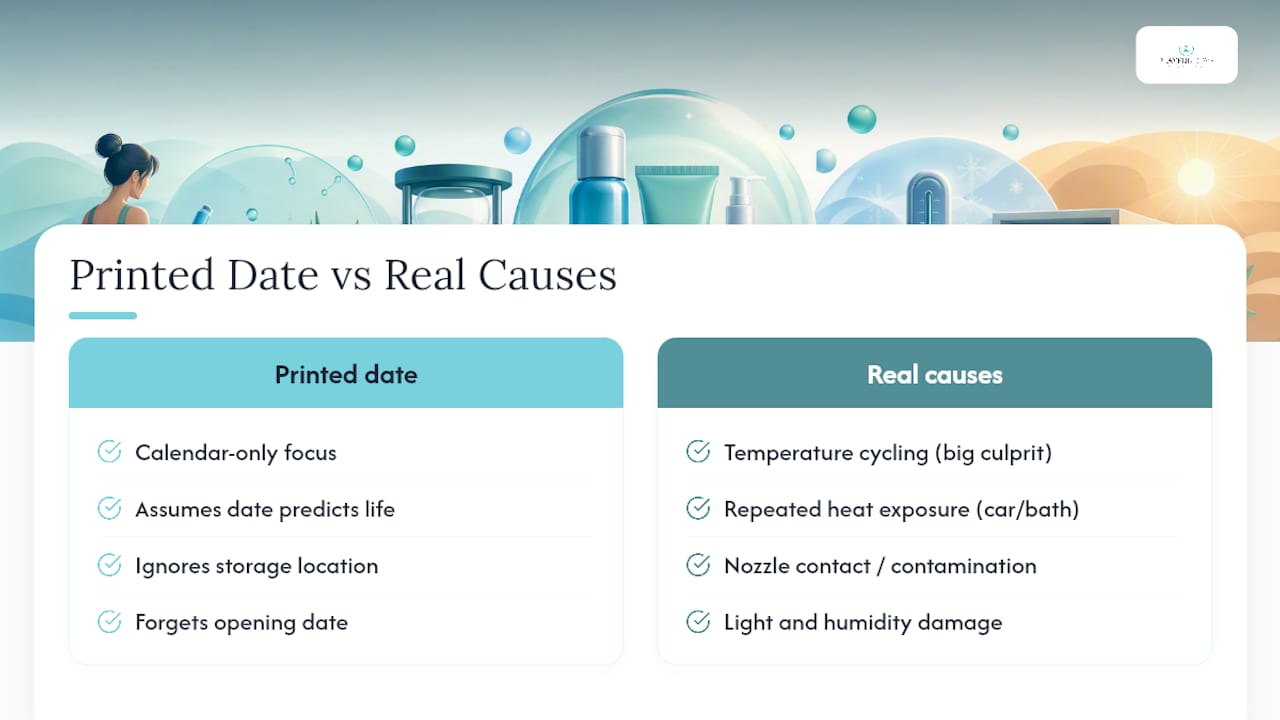
Temperature cycling is the quiet culprit nobody talks about enough. A steady warm room does less damage than a bottle that swings between a heated car and an air-conditioned house week after week. If you take one thing from this article, make it storage location, not just storage duration.
The second most overlooked habit is the simplest: mark the date the moment you open something. Nobody remembers whether they opened a bottle in March or September six months later, and that guesswork is exactly how people end up using something well past its safe window without realizing it.
Fresh Lube and Applicators That Make Storage Easier
A fresh bottle with a clear opening date beats guessing about one that’s been sitting around for a year. Playful Cove carries water-based options like the Mood Lube Water Based Lubricant in packaging sized to finish within a normal PAO window, so you’re not stuck stretching a bulk bottle past its prime.
If hygiene is your main concern, pair any lube with a Lube Tube applicator for single-use, contamination-free application, especially useful for shared use or travel. For those with sensitive skin, our guide to fragrance-free lube options covers simpler formulas that tend to be more forgiving in storage. Browse the full lube selection on Playful Cove and pick a size you’ll actually finish, in discreet packaging shipped straight to your door.
Sources
- Does Personal Lubricant Expire? Shelf Life, Storage & Safety Guide – SUPER SLIK
- Condoms
- Does Lube Expire? Shelf Life, PAO Symbols & Safety Guide – Pleasure Empire
- Does Lube Expire? Gynecologists Weigh In | PS Sex
