

Your correct lingerie size comes down to two measurements: your underbust (band) and your fullest bust (cup). Add your hip measurement for panties, bodysuits, and one-piece styles. Once you have those three numbers, any brand chart becomes readable, and online shopping gets a lot less stressful.
Start here:
- Grab a soft measuring tape and measure your underbust snugly, then your fullest bust.
- Subtract band from bust to find your cup letter using the conversion table below.
- Check the specific brand chart before ordering, since sizing varies across brands even when the label reads the same.
- Order your baseline size plus one sister size when buying online.
Think of your size as a starting range, not a fixed identity. Bodies change, brands differ, and a 34C in one label might feel like a 32D in another. That flexibility is normal, and this guide shows you exactly how to use it.
Pro Tip: Keep your measurements on your phone. You will use them more often than you expect, especially when shopping online.
Key Takeaways
Measuring your underbust and full bust accurately, then using sister sizes to fine-tune fit, is the most reliable path to comfortable, well-fitting lingerie across any brand or style.
| Point | Details |
|---|---|
| Band measurement comes first | Measure snugly under the bust; round to the nearest even number for your band size. |
| Cup size is a difference, not a fixed letter | Subtract band from bust in inches; each inch maps to one cup letter up the scale. |
| Sister sizes give you flexibility | A 34C, 32D, and 36B share similar cup volume — use them to fine-tune band or cup fit. |
| Style and fabric shift the fit | Plunge, moulded, and stretch-lace styles all fit differently even at the same labeled size. |
| Playful Cove makes online sizing easier | Curated lingerie with discreet shipping and easy returns lets you order two sizes risk-free. |
Table of Contents
- How to use a lingerie size guide to measure yourself accurately
- How to calculate cup size from your bust-to-band difference
- Standard lingerie size charts and how to read brand charts
- How bra and lingerie styles change fit and sizing
- Fit checklist: signs of poor fit and quick fixes
- What to do when you fall between sizes and how to shop online
- A fit specialist’s perspective on sizing and confidence
- Playful Cove lingerie: curated styles, discreet shipping, and easy returns
- Sources
How to use a lingerie size guide to measure yourself accurately
Getting accurate numbers is the whole foundation. Sloppy measuring leads to wrong sizes, which leads to returns. Here is how to do it right, according to Farnelli’s comprehensive sizing guide.
Band (underbust)
Wrap your tape snugly around your ribcage, directly under your bust. Keep it parallel to the floor all the way around. Breathe out normally, then read the number. If you land on an odd number, round up to the next even number. That is your band size.
Full bust
Stand naturally, arms relaxed at your sides. Measure around the fullest part of your chest, usually across the nipples. Keep the tape level and just snug enough that it does not sag at the back. Do not compress the tissue.
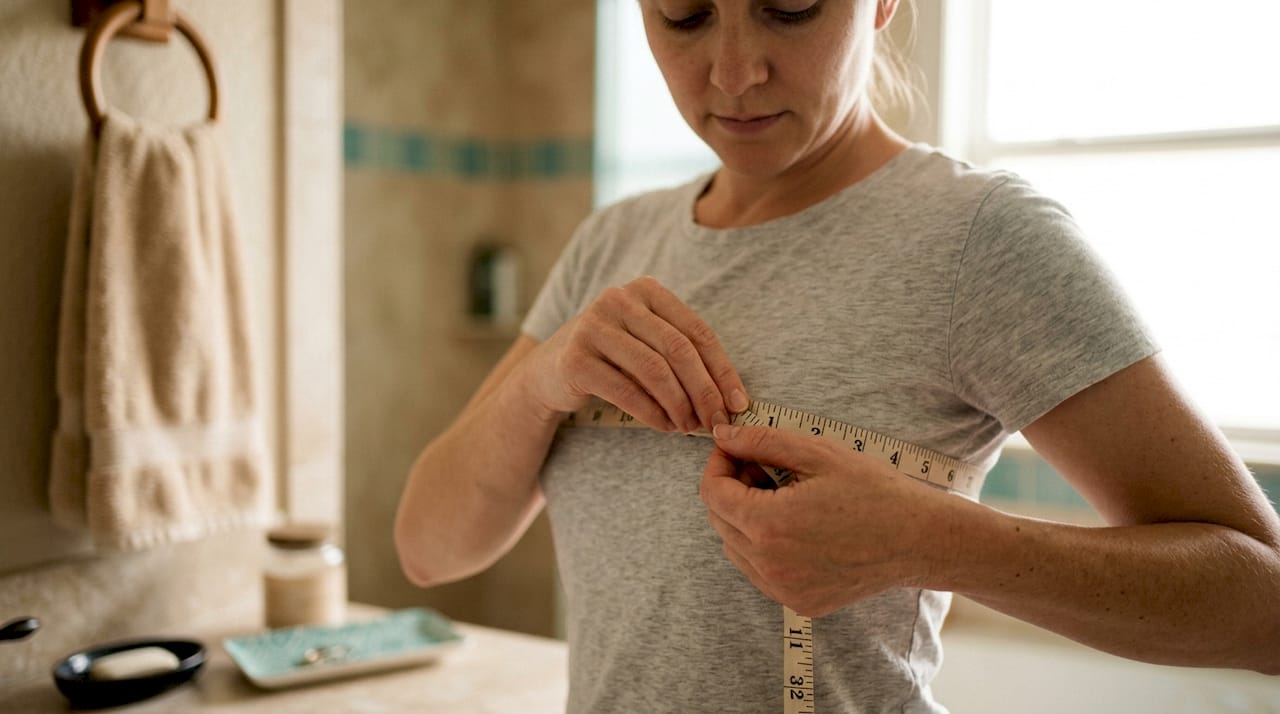
Waist and hips
For panties, bodysuits, and corsets, measure your natural waist (the narrowest point, usually an inch above your navel) and your hips at the fullest point, typically 7–9 inches below the waist. Hip measurement is the key number for most panty size charts.
Practical tips that actually matter:
- Measure on bare skin or a thin, non-padded bra. Padded cups add false inches.
- Always stand. Lying down or leaning forward changes your numbers.
- Use a fabric tape, not a metal one.
- Re-measure every 6–12 months, or after any significant body change.
- Start new bras on the loosest hook so the band can tighten as the elastic relaxes over time.
Pro Tip: If you do not own a soft measuring tape, a piece of string and a ruler work just as well. Mark the string, lay it flat, and measure the length.
How to calculate cup size from your bust-to-band difference
Once you have your band and bust numbers, the cup letter is simple math. Subtract your band measurement from your full bust measurement. That difference, in inches, maps directly to a cup letter.
| Difference (inches) | Cup size |
|---|---|
| 1 | A |
| 2 | B |
| 3 | C |
| 4 | D |
| 5 | DD / E |
| 6 | DDD / F |
| 7 | G |
So if your underbust is 34 inches and your full bust is 37 inches, the difference is 3 inches, which maps to a C cup. Your starting size is 34C.
Sister sizes: the most useful tool you are probably not using
Sister sizes keep cup volume roughly the same while shifting the band up or down. A 34C, 32D, and 36B all hold similar cup volume on paper, according to EatHealthy365’s breakdown of cup size variation. Use this when:
- The band fits but the cup is slightly off. Go up or down one cup and stay on the same band.
- The cup fits but the band is too tight. Try the next band size up and drop one cup letter.
- The cup fits but the band is too loose. Try the next band size down and go up one cup letter.
DDD vs. F: which one is right for you?
This trips up a lot of shoppers. On the same band size, an F cup runs about one cup step deeper than a DDD, roughly a one-inch increase in the bust-to-band difference. Bra-Calculator’s DDD vs. F comparison recommends trying both in the same bra model to confirm which fits your shape. Some brands use DDD and F interchangeably; others treat them as distinct steps. Check the brand’s own chart first.
Standard lingerie size charts and how to read brand charts
Bra size reference
Panty size reference (US)
For plus-size fits, hip measurement is the most reliable anchor. A style like the Leg Avenue Plus Size Industrial Net Biker Shorts typically follows this hip-first sizing logic.
International conversions at a glance
US sizing and UK sizing share the same band numbers but diverge in cup letters after D. The UK sequence runs D, DD, E, F, FF, G, while the US sequence runs D, DD, DDD, G. EU sizing uses centimeters for the band (add roughly 10–15 cm to the US band number) and its own cup letter sequence. A US 34DD is roughly a UK 34DD but may be labeled an EU 75E. Always cross-check the brand’s own conversion chart, because cup label sequences diverge across systems, especially in fuller sizes.
How to read any brand chart:
- Find the column that matches your key measurement (band for bras, hips for panties).
- Read across to the labeled size the brand assigns to that measurement.
- Check any style notes in the product description (runs small, firm band, stretch lace).
- Note the return policy before ordering. A generous return window is your safety net.
Brand-specific decoder tools can translate your baseline size into a brand’s own starting size, accounting for band tension and cup depth. Use them as a starting point, not a final answer, as Bra-Calculator’s brand size decoder makes clear.
How bra and lingerie styles change fit and sizing
The label on the tag is only part of the story. Construction changes everything about how a size actually feels.
Plunge bras have a low center gore and wide-set cups. They tend to feel smaller in the cup for fuller shapes because the cup does not extend as high. If you spill at the top in a plunge, try a cup up before switching styles entirely. The Leg Avenue Plunging Lace Halter Babydoll is a good example of this silhouette, where fit at the bust and waist matters more than a single size number.
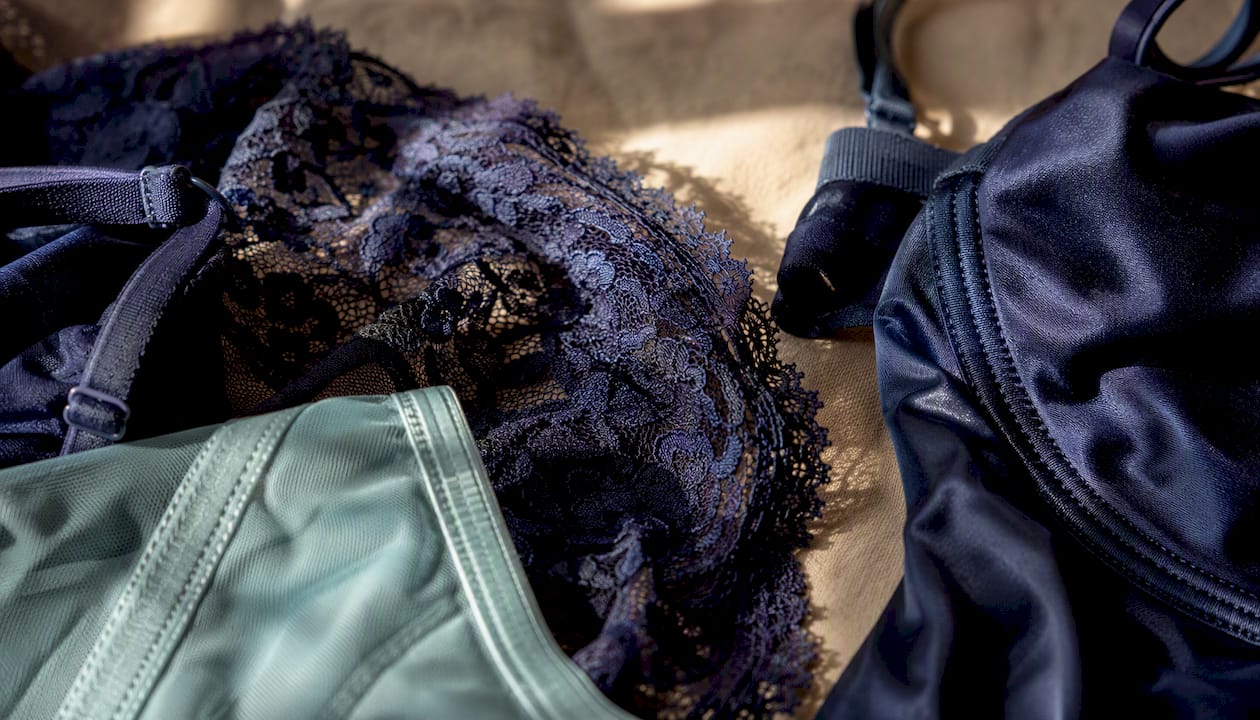
Balconette bras lift and project forward. The cup height is shorter, so they can create spillage at the top for those with fuller upper poles. A cup up often solves this.
Full-coverage bras encase the whole breast and tend to run true to size. Moulded foam cups are pre-shaped, so they fit differently than stretch lace. A moulded cup that does not match your breast shape will gap or compress regardless of the label.
Bralettes are typically sized in XS–XL rather than band-and-cup. They work best for A–C cups in most brands, though some extended-size bralettes reach DD and beyond. Stretch lace gives more than power mesh, so a bralette in stretch lace may fit one size larger than the same style in a firmer fabric.
Fabric matters more than most shoppers realize. High-elastane fabrics stretch and recover, which means they may feel looser after a few wears. Firmer fabrics, like power mesh or structured satin, hold their shape but feel snugger initially. If a band feels tight in a firm fabric, try a sister size with a looser band before dismissing the style entirely, since fabric and construction directly affect how a labeled size fits.
Fit checklist: signs of poor fit and quick fixes
A bad fit is almost always fixable once you know what to look for.
- Band rides up at the back. The band is too large or not level. Try a sister size with a tighter band, or fasten on a tighter hook.
- Straps dig in or fall off. Straps are doing the support work the band should handle. Tighten the band first. If straps still dig, the cups may be too small, pulling the straps forward.
- Spillage or “quad-boob” at the top. Cups are too small. Go up one cup, or try a sister size with a larger cup on the same band.
- Cup gaping or wrinkling. Cups are too large, or the cup shape does not match your breast shape. Go down one cup, or try a different style with a shallower cup.
- Underwire poking or sitting on breast tissue. The cup is too small, or the underwire width does not match your breast root. Try a wider-gore style or go up a cup.
- Gore (center panel) floating away from the sternum. The cup is too small, or the style is not suited to your shape. Go up a cup or try a plunge with a lower gore.
Try-on protocol: Put the bra on, lean forward to let tissue settle into the cups, then stand upright. Do a reach-and-stretch to check strap security. Check wire placement with two fingers. Fasten on the loosest hook for a new bra.
Pro Tip: Do the “jump test.” A quick bounce in place tells you immediately whether the band is doing its job or the straps are carrying all the weight.
What to do when you fall between sizes and how to shop online
Falling between sizes is not a problem. It is just information. Here is how to use it.
- Order your baseline size and one sister size. If you measure as a 34C but the band feels borderline, order a 34C and a 32D in the same style. Return whichever does not work.
- Read customer reviews for fit language. Phrases like “runs small,” “band tight,” or “true to size” tell you more than the size chart alone. Search for reviews from people with a similar band-to-cup ratio.
- Check the return policy before you buy. Free returns make the two-size strategy risk-free. If returns are paid, factor that cost into your decision.
- Try on with clean skin, no lotion. Keep the tags attached and the original packaging intact until you are sure of the fit.
- For panty-style items like the My Secret Premium Ergonomic Panty Vibe Set, hip measurement is the primary fit anchor. When in doubt, size up for comfort.
- Use brand decoder tools as a first pass when trying a new brand. They account for brand-specific band tension and cup depth, which saves a round of returns.
When shopping in person, bring three sizes: your baseline, the sister size with a tighter band, and the sister size with a looser band. That three-size approach typically finds the right fit without a second trip.
A fit specialist’s perspective on sizing and confidence
Most shoppers have been wearing the wrong size for years, and the surprising part is that it is rarely their fault. Sizing systems were never standardized globally, and brands set their own grading rules. A size on a tag is a starting point, not a verdict.
The most freeing shift is treating your size as a range. Once you know your band measurement is reliable and your cup floats across two or three letters depending on the brand and style, shopping becomes much less frustrating. You stop chasing a number and start chasing a fit.
At Playful Cove, the approach is to give shoppers the tools to measure confidently, understand sister sizing, and know what to look for when something does not feel right. Lingerie should feel good from the first wear. If it does not, the size is wrong, not your body.
Playful Cove lingerie: curated styles, discreet shipping, and easy returns
Finding the right fit is only half the equation. The other half is finding styles you actually want to wear.
Playful Cove carries a curated selection of lingerie, from floaty babydolls like the Leg Avenue Lace Flyaway Babydoll to plunge styles and plus-size options, all shipped in discreet packaging with no identifying labels. Every order arrives privately, so you can shop and try on with complete confidence.
If a size does not work, the return process is straightforward. Order your baseline size and a sister size, try both, and send back what does not fit. Playful Cove’s lingerie collection is a comfortable, judgment-free place to find something that feels as good as it looks. Browse the full lingerie collection at Playful Cove and use the size charts on each product page as your first reference.
Sources
These are the references behind the measurement rules, sister-size logic, and conversion guidance in this guide.
- Why Your Bra Size Changes from Brand to Brand (And Why It’s Completely Normal) | iLounge
- Lingerie: The Ultimate Comprehensive Sizing Guide | Farnelli
- Brand Size Decoder: Why Your Size Changes by Store (2026) | Bra-Calculator
Recommended
- Leg Avenue Lace Flyaway Babydoll with Ruffle Peek-A-Boo Cups and Lace G-String – Playful Cove
- Leg Avenue Plunging Lace Halter Babydoll with Sheer Skirt and Lace G-String – Playful Cove
- Leg Avenue Plus Size Industrial Net Biker Shorts - 1x-2x – Playful Cove
- Menopause Dryness Lubricant: Your Comfort Guide for 2026 – Playful Cove
