

Consensual sexting can safely deepen intimacy and connection when both partners are on the same page. Here is a simple plan to get started today: (1) ask for ongoing consent before you begin, (2) pick a tone that matches your mood and send a short opener, (3) follow basic privacy rules so both of you feel secure. Research consistently links mutual, wanted sexting to greater relationship satisfaction, so the foundation is always enthusiastic agreement, not assumption.
Two messages you can send right now:
Playful: “I keep thinking about you today. Is it weird that I can’t focus? 😏”
Romantic: “I just wanted you to know that I’m really looking forward to tonight. You’ve been on my mind all day.”
That’s the whole framework. Everything below expands on it with ready-to-send examples, safety steps, and long-distance tactics.
Key Takeaways
Consensual, mutual sexting tends to strengthen intimacy and relationship satisfaction when both partners have agreed explicitly to the content, tone, and privacy rules before they begin.
| Point | Details |
|---|---|
| Consent comes first | Ask explicitly before starting and check in throughout; a yes to texting is not a yes to photos or explicit content. |
| Match tone to comfort level | Start playful and only escalate when your partner actively matches your energy and has agreed to go further. |
| Privacy steps are non-negotiable | Crop identifying marks, remove metadata, and treat every image as potentially permanent regardless of the app used. |
| Long-distance works best with pacing | Slow-burn sequences, voice notes, and scheduled sessions sustain desire more effectively than a single explicit exchange. |
| Playful Cove as an enhancer | Remote-control toys and sensual products from Playful Cove can deepen the connection sexting builds, with discreet U.S. shipping on every order. |
Table of Contents
- Sexting ideas for couples: your full message menu by tone
- How to start sexting your partner and build from there
- Long-distance sexting ideas that build real anticipation
- Consent and etiquette: what to do and what to never do
- Privacy and safety: protecting yourself before you send anything
- Going beyond text: voice notes, photos, and other formats
- How to recover when something goes wrong
- What research says about sexting and why the core conversations matter
- Your quick-reference message menu: 20 copy-paste lines
- Our perspective on consent, privacy, and what toys can add
- Playful Cove products that pair well with your sexting sessions
- Sources
Sexting ideas for couples: your full message menu by tone
Not every mood calls for the same kind of message. The categories below let you match your energy to your partner’s without guessing. Start in the playful zone if you are new to this, and only move into spicier territory once you have both agreed to go there.
Playful and flirty
These work any time of day and carry zero pressure. They are perfect openers or check-ins.
- “You looked really good this morning. Just thought you should know.”
- “I have a very distracting thought about you and I’m not going to share it yet. 😈”
- “What are you wearing right now? Asking for science.”
- “I dare you to send me your favorite emoji that describes your mood right now.”
- “I’m bored. Entertain me. But make it interesting.”
Best for: Morning texts, lunch-break check-ins, or any time you want to spark a smile without escalating.
Romantic and anticipatory
These build emotional closeness and create a slow, warm burn of anticipation.
- “I’ve been thinking about the last time we were together. I want to recreate that.”
- “I miss the way you smell. Is that too much? I don’t care.”
- “Tonight I want to take my time with you. No rushing.”
- “You make me feel so comfortable and so turned on at the same time. That’s rare.”
- “I keep replaying that moment last week. You have no idea what you do to me.”
Best for: Evenings, after a meaningful conversation, or when you want to deepen emotional intimacy alongside physical desire.
Spicy and explicit (for established consent only)
Only use these after you have had an explicit conversation confirming both partners are comfortable with direct language. Consent here is not implied by the relationship; it is stated.
- “I want to feel your hands on me right now.”
- “Tell me exactly what you’d do if you were here.”
- “I’ve been thinking about [specific thing you both enjoy]. I need that tonight.”
- “I’m already thinking about what I’m going to do to you later.”
- “What’s the one thing you want me to do that I haven’t done yet?”
Best for: Established couples with explicit agreements about explicit content; evenings or private moments when both partners have privacy.
Fantasy and roleplay prompts
These open a creative space without locking either partner into anything. Frame them as invitations, not scripts.
- “Okay, new scenario: you’re a stranger I just met at a hotel bar. Go.”
- “What if we pretended tonight was our first time? I’d do everything differently.”
- “I want to play a game. You give me one rule, I give you one. Deal?”
- “Tell me a fantasy you’ve never said out loud. I’ll tell you mine after.”
Best for: Partners who enjoy creative play and have already talked about comfort levels with roleplay themes.
Simple escalation sequence
A PG-13 to R-rated path that lets you read the room at each step:
- “You’ve been on my mind.” (gauge interest)
- “I keep thinking about [a specific, non-explicit memory].” (add warmth)
- “I really want to [action] with you later.” (introduce intention)
- “Tell me what you want.” (invite participation)
- “I’ll show you exactly what I mean tonight.” (close the loop in person)
If your partner matches your energy at each step, continue. If they respond briefly or change the subject, pause and check in directly.
How to start sexting your partner and build from there
The biggest barrier for most couples is not knowing how to open the conversation. A direct, low-pressure ask works far better than hinting or assuming.
Getting explicit consent
Before you send anything, have a short out-of-text conversation. This can happen in person or over a regular call. Try one of these openers:
- “I’ve been thinking it could be fun to flirt more over text. Would you be into that?”
- “I want to try something a little more playful in our messages. Are you comfortable with that?”
- “Can we set some ground rules for what we’re both okay with before we start?”
A yes here is your green light for the playful and romantic categories. Explicit content requires a second, specific conversation. Consent in digital sexual communication is ongoing and can be withdrawn at any time, so checking in periodically is not awkward; it is respectful.
Reading cues and pacing
Watch for these signals that your partner is engaged and comfortable:
- They match your energy or raise it
- They initiate messages or ask questions
- Their responses are specific, not one-word
Signs to slow down or check in:
- Short, vague replies (“lol,” “haha,” “sure”)
- Delayed responses with no explanation
- A topic change without acknowledgment
When you are unsure, ask directly: “Are you still feeling this? We can totally switch gears.” That one sentence removes pressure from both sides.
If your partner says no or seems unsure
Graceful responses matter. Try:
- “Totally fine, no worries at all. Want to talk about something else?”
- “I appreciate you telling me. Let me know if you ever want to revisit it.”
Never push back, guilt-trip, or ask “why not?” A no is complete information.
Long-distance sexting ideas that build real anticipation
Long-distance couples often rely on sexting more heavily, and the tactics that work best are not the most explicit ones. Pacing and sensory detail carry more weight than graphic content. Practical guides for long-distance couples recommend mixing teasing, scheduled play, voice notes, and shared rituals to sustain desire across distance.
The slow-burn sequence
Spread a single narrative across a full day or even a week. Each message adds one detail without resolving the tension:
- Morning: “I had a dream about you last night. I’m not going to tell you what happened yet.”
- Midday: “Still thinking about that dream. It involved [a place you’ve both been].”
- Evening: “Okay. I’ll tell you everything tonight at 9. Clear your schedule.”
The anticipation itself becomes the intimacy.
Voice notes
A short, breathy voice note often lands with more emotional weight than a paragraph of text. Keep them under 30 seconds. Try:
- “I just wanted to hear my own voice saying your name.”
- “I’m about to go to sleep and I wanted the last thing I did to be thinking about you.”
Timing matters. Send voice notes in the evening when your partner has privacy, not during their work commute.
Scheduled play checklist
Before a planned long-distance session, run through this short list:
- Confirm time zones and agree on a specific start time
- Both partners have a private window (no roommates, family, or work calls)
- Devices are charged and notifications from other apps are silenced
- Agree in advance on the format: text only, voice notes, or a live call
- Have a safe word or phrase to pause or stop at any time
A little planning removes friction and lets both of you actually be present.
Consent and etiquette: what to do and what to never do
Respectful sexting is not complicated, but it does require intention. These rules apply whether you have been together for three weeks or ten years.
Do these
- Ask explicitly before sending anything sexual, every time you start a new session.
- Check in during a sexting exchange if the tone shifts or the conversation goes quiet.
- Use enthusiastic consent language: “Is this okay?” “Do you want more?” “Tell me if you want to stop.”
- Respect a no immediately and without negotiation.
- Delete content when your partner asks you to.
- Agree in advance on what kinds of content are on the table.
Never do these
- Send unsolicited explicit images or messages.
- Use guilt-tripping language like “If you loved me, you’d send this.”
- Screenshot or save content without permission.
- Share any message or image with a third party.
- Pressure a partner who has said no or seems hesitant.
- Use sexting as a substitute for a real conversation about a relationship problem.
Red flags to watch for
According to loveisrespect.org, coercive phrases are a sign of a problem, not intimacy. Watch for:
- “You used to be more fun.”
- “Everyone does this, why won’t you?”
- “I’ll be upset if you don’t.”
- “You owe me this.”
Any of these phrases signals manipulation, not desire. Sharing sexual images without consent is considered a form of sexual violence, and explicit agreements about sharing and storage are not optional extras; they are foundational.
Response templates when a partner withdraws consent
- “Got it. Thank you for telling me. We don’t have to continue.”
- “I hear you. Let’s talk when you’re ready.”
- “No explanation needed. I’m glad you said something.”
Privacy and safety: protecting yourself before you send anything
Every piece of digital content you send carries some risk. These steps reduce that risk significantly without requiring technical expertise.
Before you send any image
- Crop your face and any identifying marks (tattoos, birthmarks, distinctive jewelry).
- Use a neutral background. A blank wall tells a stranger nothing; your bedroom with family photos does.
- Remove metadata. Photos taken on a smartphone embed GPS coordinates and device information by default. On iOS, turn off location services for your camera app. On Android, disable geotagging in your camera settings.
- Avoid showing location clues like recognizable landmarks, street signs, or distinctive furniture.
Public-health guidance from Indiana University Health Center specifically recommends cropping identifying marks and being aware that ephemeral apps are not fully protective. Screenshots and screen recordings can capture anything before it disappears.
Pro Tip: Treat every image you send as potentially permanent. If you would not want it seen by someone outside the relationship, apply the cropping and metadata steps above before sending, regardless of the app you use.
Sextortion red flags
Sextortion occurs when someone threatens to share your images unless you comply with demands. Watch for:
- A new or recently met contact who quickly asks for explicit images
- Requests to move the conversation to a less secure platform
- Any message that says “I have your photos and I’ll share them unless…”
If your images are shared without permission
- Preserve evidence by screenshotting the threat or post before reporting.
- Report to the platform where the content appears; most major platforms have a non-consensual intimate image removal process.
- Contact the Cyber Civil Rights Initiative (cybercivilrights.org) for free, confidential support.
- File a police report. Non-consensual sharing of intimate images is illegal in most U.S. states.
- Community safety resources also recommend not sexting people you have not verified offline and setting clear boundaries before any images are exchanged.
Going beyond text: voice notes, photos, and other formats
Variety keeps long-term sexting fresh. Each format carries a different intimacy level and a different privacy risk, so choosing the right one depends on your comfort and your situation.
Voice notes
Short audio clips add sensory immediacy that text cannot replicate. A whispered 20-second message creates a sense of physical presence. Keep them specific and personal rather than scripted. Try: “I just wanted to hear myself say this to you: I’ve been thinking about you all afternoon.”
Photo prompts (with safety rules applied)
A photo does not have to be explicit to be intimate. A close-up of your hand, a collarbone shot, or a photo of something that reminds you of your partner can carry real emotional weight with minimal privacy risk. Apply all the cropping and metadata steps from the privacy section above before sending anything.
Format comparison
| Format | Intimacy level | Privacy risk | Best use case |
|---|---|---|---|
| Text message | Moderate | Low | Daily flirting, escalation sequences |
| Voice note | High | Low to moderate | Long-distance, emotional connection |
| Photo | High | Moderate to high | Established couples with privacy steps applied |
| Video | Very high | High | Only with full consent and metadata removed |
| Live video call | Very high | Moderate | Scheduled sessions with private windows confirmed |
A few practical notes on photos and video
- Never send video without the same cropping and metadata precautions you would apply to a photo.
- Live video calls carry less permanent risk than recorded content, but screen recording is still possible.
- For any format beyond text, revisit your consent conversation specifically about that format. Agreement to text-based sexting is not blanket agreement to photos or video.
How to recover when something goes wrong
Mistakes happen. An autocorrect disaster, a message sent to the wrong contact, or a moment where one partner feels uncomfortable are all recoverable. What matters is how quickly and honestly you respond.
Accidental sends
If you send a message to the wrong person:
- Act immediately. Delete the message if the platform allows it, then send a brief, calm follow-up: “So sorry, that was meant for someone else. Please disregard.”
- Do not over-explain or panic in the follow-up message. One clear sentence is enough.
- Tell your partner what happened. Transparency prevents the situation from becoming a trust issue.
If autocorrect turns a romantic message into something confusing or unintentionally funny, use it. Sexting coaches often recommend a playful recovery: “Okay, autocorrect just ruined the mood. Let me try that again.” Humor resets the tone without embarrassment.
When a partner withdraws consent mid-session
Stop immediately. Do not ask for a reason in the moment. Send one of the response templates from the consent section above and give your partner space. When you both feel ready, have a calm conversation about what happened and whether you want to continue sexting at all.
When to pause sexting entirely
Consider a pause if:
- One partner consistently feels pressured, even subtly
- Sexting is being used to avoid a real conversation about the relationship
- Either partner has experienced a recent breach of privacy or trust
- The content has escalated beyond what both partners genuinely want
- One partner is going through a stressful period and needs emotional support, not erotic play
A pause is not a failure. It is a sign that you are paying attention to each other.
What research says about sexting and why the core conversations matter
Studies indexed in PMC document that outcomes from sexting vary considerably depending on whether the exchange is consensual and mutual. Coerced or nonconsensual sexting links to harm, while wanted, mutual sexting tends to correlate with positive relationship outcomes. Research published in MDPI specifically found that consensual sexting among committed partners is associated with higher sexual and relationship satisfaction in emerging adults, though the authors note these findings are context-dependent.
Relationship-focused commentary adds that mutual sexting can improve sexual communication, boost confidence, and reinvigorate long-term partnerships. The common thread across all of this: the word “consensual” is doing most of the work.
The three core conversations to have before you start
1. Consent agreements. Agree explicitly on what kinds of content are welcome: text only, photos, video, explicit language, roleplay. Revisit this conversation if either partner wants to change the scope.
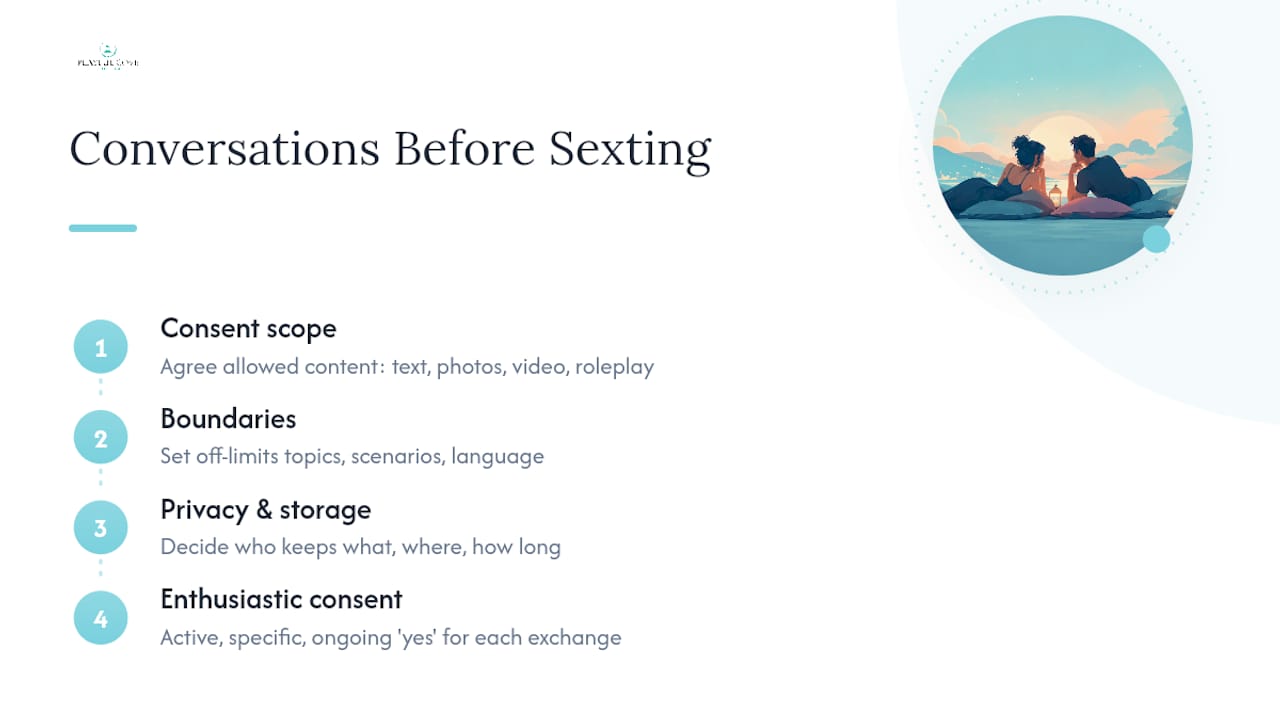
2. Boundaries and content rules. Decide together what topics, scenarios, or language are off-limits. This is not a mood-killer; it is what makes the space feel safe enough to actually play in.
3. Privacy and storage expectations. Who stores what, for how long, and on which devices? Will you delete content after a session? These questions feel administrative, but they protect both of you.
Enthusiastic consent means both partners are actively, freely, and specifically agreeing to each exchange. It is ongoing, not a one-time checkbox. If you are ever unsure whether your partner is still comfortable, ask. A confident “yes” is the only green light.
Source: loveisrespect.org
Your quick-reference message menu: 20 copy-paste lines
Consent reminder: only send these to a partner who has agreed to receive sexual or flirtatious messages. Do not save explicit exchanges on shared devices.
- [Morning / playful] “Good morning. I had a very good dream about you.”
- [Morning / romantic] “Woke up thinking about you. That’s becoming a habit.”
- [Midday / flirty] “What are you doing right now? Asking because I miss you.”
- [Midday / tease] “I have a plan for tonight. You’re going to like it.”
- [After a call / romantic] “I love the sound of your voice. I needed that today.”
- [After a call / spicy] “That call did things to me. I’ll explain later.”
- [Evening / anticipatory] “I’m counting down until I can actually touch you.”
- [Evening / explicit — established consent only] “Tell me what you want me to do when I get there.”
- [Long-distance / slow burn] “I started writing you something. I’m not ready to send it yet.”
- [Long-distance / voice note prompt] “Send me a voice note. I just want to hear you.”
- [Roleplay opener] “New game: you’re a stranger I just met. Introduce yourself.”
- [Roleplay prompt] “What’s a scenario you’ve always wanted to try? No judgment.”
- [Playful / emoji-led] “Rate this situation: 🔥 or 😂? I’ll explain after.”
- [Romantic / memory] “I keep thinking about [specific moment]. That was everything.”
- [Spicy / invitation — established consent only] “I want to try something new with you. Are you in?”
- [Check-in / consent] “Still feeling this? We can switch gears anytime.”
- [Pause / graceful] “No worries at all. Let’s talk about something else.”
- [Escalation step 1] “You’ve been on my mind all day.”
- [Escalation step 2] “I keep thinking about [a specific, non-explicit memory you share].”
- [Escalation step 3] “I’ll tell you the rest tonight.”
Our perspective on consent, privacy, and what toys can add
At Playful Cove, we believe that pleasure and safety belong together. No product, no message, and no fantasy is worth more than both partners feeling genuinely comfortable and respected. That is the value we build everything around.
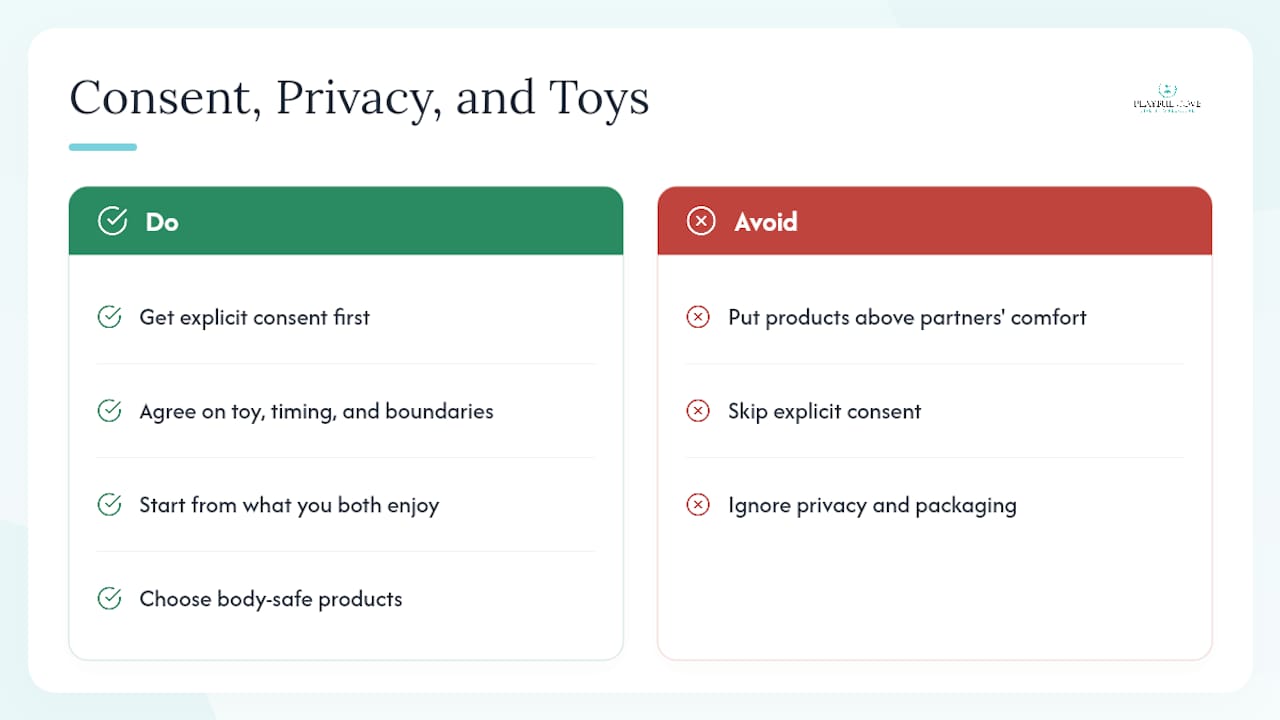
We also know that sexting and physical intimacy can complement each other beautifully. A remote-control toy worn during a voice-note session, for example, adds a sensory layer that text alone cannot. Remote-play options like a panty vibe let long-distance couples share a real-time physical experience alongside their messages, which many couples find deepens the connection considerably. But that kind of play requires an extra layer of explicit consent: agree on the toy, the timing, and the boundaries before the session begins.
Privacy matters to us on the product side too. Every order from Playful Cove ships in plain, discreet packaging with no indication of the contents. We carry only body-safe materials, and our educational content is written to help you make informed choices, not to push products. If you have questions about what might work for your situation, our support team is here without judgment.
Introducing sex toys into your intimate life, whether in person or across a distance, works best when it grows naturally from honest conversation. Start with what you both already enjoy, and let curiosity lead from there.
Playful Cove products that pair well with your sexting sessions
Sexting builds anticipation. The right product can make the payoff even better.

For long-distance couples, a remote-control thrusting dildo lets one partner take the lead from anywhere, turning a text exchange into a shared physical experience in real time. For in-person sessions, sensual massage oils make a natural bridge between the anticipation you built over text and the moment you are finally together. If you want to add a playful, low-pressure element to your routine, the Monogamy couples’ board game is a great way to generate new ideas together without any pressure.
All Playful Cove products are made from body-safe materials and ship in plain, discreet packaging throughout the United States. Browse the full collection at Playful Cove and find what fits your comfort level, your curiosity, and your relationship.
Sources
The sources below were used throughout this article. Each one covers a distinct angle on consent, safety, or the research base.
- The bright side of sexting (MDPI)
- Peer-reviewed articles on sexting (PMC)
- Loveisrespect
- Real Talk: Practice Safe Sexting | Indiana University Health Center
- Real Talk: Practice Safe Sexting | Lanark County Interval House and Community Support
- Sexting Only With Consent! (GBV Learning Network PDF)
- 7 Reasons Why Sexting is Good for Relationships | JustMind
