

You can start safely with a graduated anal training set by beginning at a very small size, using plenty of lubricant, and following a slow, patient progression. There’s no shortcut worth taking here and no prize for rushing.
Before your first session, gather a few essentials so you’re not pausing mid-session to hunt for supplies.
- A toy with a flared base (never anything without one)
- A generous bottle of water-based lubricant
- A clean towel
- Easy access to a shower
- Your smallest starter plug, or simply a well-lubricated finger
Never use numbing or desensitizing products during training. Always stop for sharp pain or any bleeding and talk to a healthcare provider if discomfort persists beyond a session or two.
Key Takeaways
Safe anal training depends on starting small, using generous lubrication, progressing only when a size feels fully comfortable, and never masking pain with numbing products.
| Point | Details |
|---|---|
| Start smaller than expected | Choose the narrowest comfortable size in your set rather than guessing high. |
| Progress by comfort, not calendar | Size up only after several pain-free, relaxed sessions at your current size. |
| Match lube to material | Use water-based lube with silicone toys; silicone or oil-based lube works with glass and metal. |
| Skip numbing products and frequent douching | Both remove useful warning signals or disrupt normal rectal flora over time. |
| Shop with Playful Cove | Playful Cove’s starter kits pair small, body-safe sizes with matched lubricant and discreet shipping. |
This article is general information, not a substitute for advice from a qualified doctor. Consult a qualified healthcare professional about your own circumstances before acting on anything here.
Table of Contents
- What Is Anal Training, and How Does an Anal Training Set Work?
- What’s Included in a Beginner Anal Training Kit?
- Which Materials and Lubricants Work Best Together?
- How Much Lubricant Do You Actually Need?
- Do You Need to Douche Before Training?
- What Does a Step-by-Step Training Schedule Look Like?
- How Do You Choose Your Starting Size?
- What Are the Non-Negotiable Safety Rules?
- How Should You Clean and Store Your Toys?
- What Should You Do When Training Doesn’t Go Smoothly?
- What’s a Good Starter Kit to Buy?
- An Editor’s Perspective on Taking Your Time
- Ready to Build Your Starter Kit?
- Sources
What Is Anal Training, and How Does an Anal Training Set Work?
Anal training is the gradual, paced conditioning of the anal sphincters so that penetration becomes comfortable rather than tense or painful. It works on two muscles at once: the external sphincter, which you can consciously relax, and the internal sphincter, which only adapts through repeated, gentle exposure over time. An anal training set gives you a structured way to do this, offering a sequence of sizes small enough that no single step feels like a leap.
This approach works for people preparing for anal intercourse, pegging, prostate play, or simply anal toys they want to enjoy without bracing against them. Some people train solo; others prefer a partner guiding the pace, which can add reassurance if nerves are part of the challenge.
Timelines vary enormously. Some beginners feel ready to size up within a couple of weeks; others need a couple of months. Both are normal. Short, regular sessions beat sporadic long ones, and consistency matters more than any fixed calendar.
What’s Included in a Beginner Anal Training Kit?
A typical anal training set gives you graduated plugs or dilators that increase in size by small, manageable amounts, helping the body adjust gradually. Most kits also include a flared base or retrieval cord on every piece, a small lubricant sample, a discreet storage pouch, and basic cleaning supplies.
It helps to know what you’re actually buying:
- Anal dilator set: a series of smooth, tapered pieces designed purely for gradual stretching, often used before moving on to toys meant for pleasure.
- Butt plug starter set: multiple plug sizes in one box, typically with a narrow tip and a wider base for a more session-ready feel.
- Training dildo: longer and sometimes textured, useful once you’ve built comfort with basic insertion and want to explore movement.
When you’re evaluating a beginner set, look for a genuinely small starting diameter, modest increments between sizes (not big jumps), body-safe nonporous material, a secure flared base, and sizing clearly marked on the packaging or the toy itself. Kits that increase in roughly quarter-inch steps tend to feel far more manageable than sets with erratic jumps between pieces.
Pro Tip: If you’re torn between two starting sizes, pick the smaller one. A plug that feels almost too easy on day one is exactly what makes week three comfortable.
Which Materials and Lubricants Work Best Together?
Material choice affects both comfort and safety, and it’s not a place to guess. Medical-grade silicone is flexible, body-safe, and nonporous, which makes it the most forgiving option for beginners. Glass and stainless steel are firmer, heavier, and take to temperature play well, and both clean easily since nothing can seep into the surface. Porous materials, like jelly rubber or certain PVC blends, are worth avoiding entirely for anal training. They can trap bacteria in ways that no amount of surface cleaning fully resolves.
Lubricant compatibility follows directly from material choice:
- Silicone toys → water-based lubricant. Silicone-based lube can degrade silicone toys over time.
- Glass or stainless steel toys → water-based, silicone-based, or oil-based lubricant, since none of these damage nonporous hard materials.
- Any porous toy → best avoided for anal training regardless of lube type.
Nonporous materials like medical-grade silicone, glass, and stainless steel are easier to sanitize thoroughly and far less likely to harbor bacteria between uses than porous alternatives.
If you’re shopping for a training set, a piece like the Mood Naughty 1 Silicone Anal Plug illustrates the kind of small, nonporous starter size worth looking for.
How Much Lubricant Do You Actually Need?
The rectum doesn’t produce its own lubrication the way other tissue does, so lube isn’t optional here. It’s the entire mechanism that makes gentle stretching possible instead of painful. Reapply often, even mid-session. If movement starts to feel like it’s dragging rather than gliding, that’s your cue to add more before you continue.
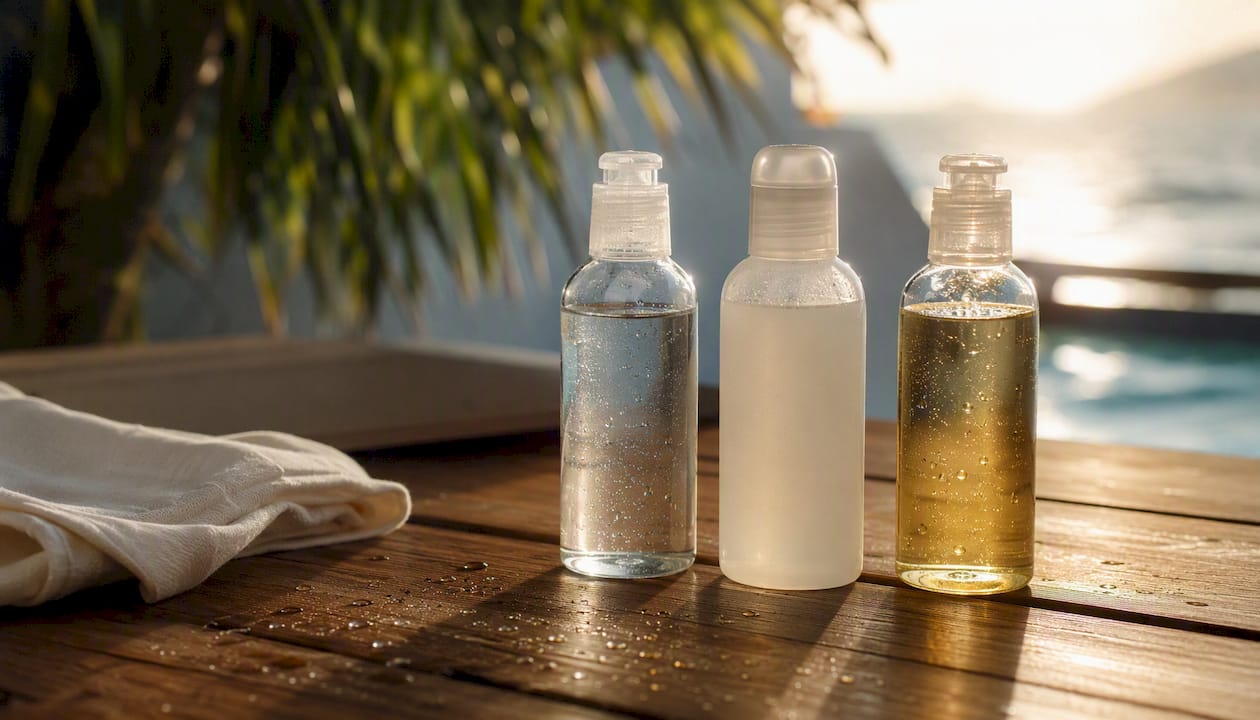
Water-based lube is the easiest starting point: it’s compatible with every toy material, cleans up without a fuss, though it does dry out faster and needs reapplying more often. Silicone-based lube lasts considerably longer per application, which is convenient, but it shouldn’t be paired with silicone toys since it can break down the material over months of repeated use. Oil-based lube lasts the longest of the three but is only appropriate for glass, metal, or condom-free solo play, since it degrades latex and most silicone.
A few rules matter more than the rest. Never reach for a numbing or desensitizing lube. Reduced sensation increases the risk of pushing past what your body can safely tolerate, since the pain signal itself is what keeps you from overextending. Skip scented or flavored formulas too, since anal tissue is more reactive to added fragrances and sugars than other skin.
Pro Tip: Keep your lubricant bottle within arm’s reach during the whole session, not across the room. Reapplying should take seconds, not require you to pause and get up.
For sessions with silicone toys, something like Mood Lube Water Based Lubricant covers the basics well, while Intimate Earth Ease Relaxing Anal Silicone Glide Lubricant is worth reserving for glass or metal pieces where longer-lasting glide matters more.
Do You Need to Douche Before Training?
Most sessions don’t require anything beyond a normal warm shower. That alone removes the concern most beginners have about hygiene, and it’s genuinely sufficient for the majority of people most of the time.
A simple prep routine looks like this:
- Use the bathroom beforehand if you’re able to.
- Take a warm shower without harsh soaps near the area.
- Keep a clean towel and easy bathroom access nearby.
- Give yourself a few unhurried minutes before starting.
If you want extra reassurance, a small anal douche can reduce the odds of encountering stool during a session. But frequent douching or full enemas can disrupt the rectum’s normal bacterial balance, so this should stay occasional rather than habitual. Deeper enemas are sometimes used ahead of more intensive play, but they’re not something a beginner training session actually calls for. If you do use one, follow the product’s instructions and use lukewarm water only.
A few small things help more than people expect:
- A warm bath beforehand relaxes muscles you didn’t know were tense.
- Slow, deliberate breathing lowers overall tension before you even start.
- Some light foreplay or arousal beforehand makes the whole body more receptive.
Showering is enough preparation for most people most of the time. Enemas are a tool for occasional use, not a daily habit.
What Does a Step-by-Step Training Schedule Look Like?
A workable plan spreads progress across roughly six to eight weeks, though your own pace might run shorter or longer. The goal at every stage is the same: comfort at your current size before you even consider the next one.
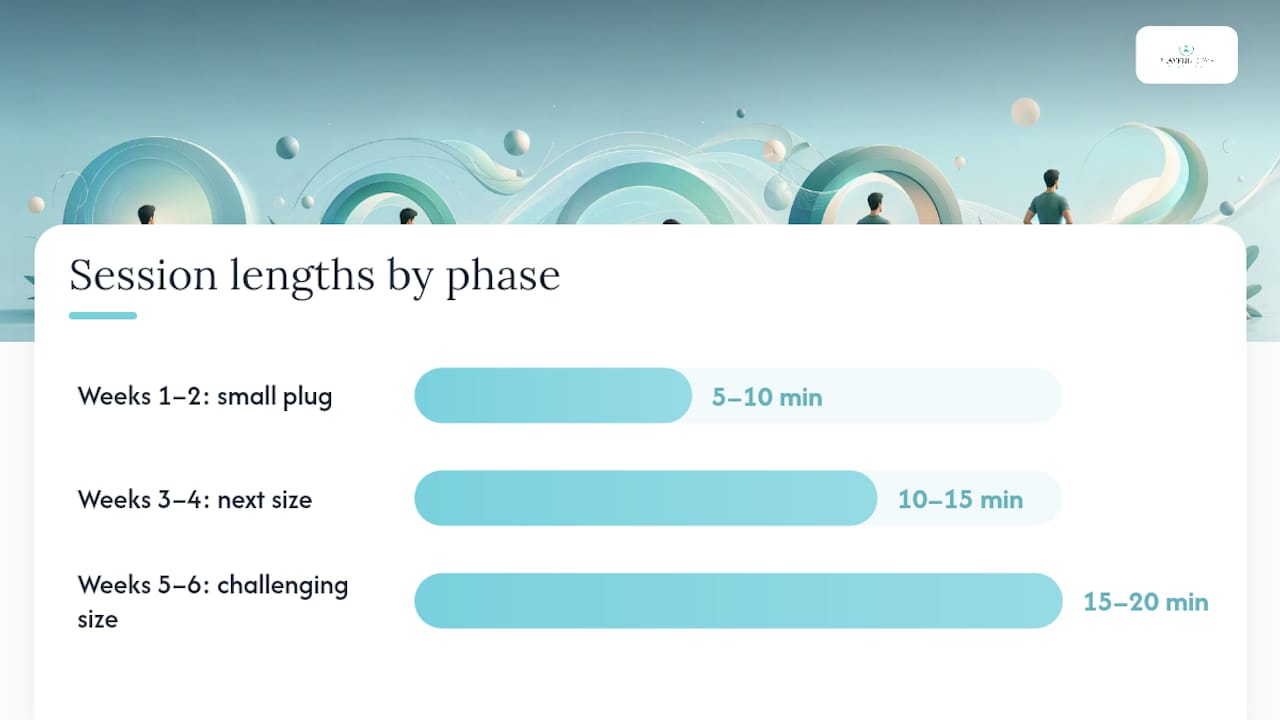
Weeks 1 to 2: Start with your smallest plug or a well-lubricated finger. Aim for sessions of 5 to 10 minutes, once or twice daily if you can manage it, which lines up with what health educators generally recommend for early-stage training. Focus purely on comfortable insertion and calm breathing. Nothing else matters yet.
Weeks 3 to 4: If insertion and removal feel easy and pain-free at your current size, move to the next size up in your set. Extend hold time gradually toward 10 to 15 minutes. Some gentle movement is fine once you’re relaxed.
Weeks 5 to 6: Continue at whatever size still challenges you slightly without causing pain. Sessions can stretch to 15 to 20 minutes. This is usually where confidence starts to build noticeably.
Weeks 7 to 8 and beyond: Keep progressing only when the current size genuinely feels easy, not just tolerable. Some people plateau here for a while, and that’s fine.
A single session breaks down into five stages: warm up with a few minutes of relaxation and lube, insert slowly, hold and adjust to the sensation, add gentle movement if it feels good, then remove slowly and clean up.
Position matters more than most guides mention. Side-lying with knees drawn up slightly reduces tension in the hips. Hands-and-knees gives you more control over the angle and depth. Reclining, propped on pillows, works well for partner-assisted sessions because it keeps you visible and relaxed rather than braced. Try a few and notice which one lets your body actually settle.
For insertion technique itself:
- Breathe slowly and consciously relax the muscles around the opening, don’t clench in anticipation.
- Apply the toy with gentle, steady pressure rather than pushing.
- Pause the moment you feel resistance, add more lube, and try again.
- If discomfort doesn’t ease within a few seconds, back off and try later rather than pushing through.
The progression rule that matters most: stay at a size until insertion and removal both feel comfortable, without any bracing or forced relaxation, for several consecutive sessions. That’s your signal to size up, not the calendar and not how quickly you’d like to be done. Jumping a size before you’re ready is the single most common cause of unnecessary pain in early training.
Partner-assisted sessions add one more layer: clear, ongoing communication. Agree beforehand on a stop signal, check in verbally during the session, and remember that pacing and consent matter just as much here as they would in any other kind of shared intimacy.
How Do You Choose Your Starting Size?
A useful mental shortcut: a single well-lubricated finger is roughly comparable to many entry-level plugs, often somewhere around three-quarters of an inch in diameter. Two fingers together approximate a modest intermediate size, closer to an inch and a quarter. These aren’t precise measurements, but they give you a frame of reference when you’re staring at a product listing with no idea what the numbers mean in practice.
Most beginner sets start smaller than people expect, often under an inch at the narrowest point, before stepping up in gentle increments. That’s intentional. The point isn’t to reach a large size quickly; it’s to teach your body that penetration doesn’t have to hurt.
You’re ready to move up when all of the following are true:
- Insertion and removal happen without any sharp pain.
- You don’t need to consciously force yourself to relax anymore.
- You can hold the current size comfortably for your full planned session time.
- Two or three sessions in a row have felt roughly the same, meaning you’ve plateaued at ease, not just gotten through it once.
When you’re reading product specs, check whether the listed measurement is diameter or circumference. These get mixed up constantly in marketing copy, and a toy described as “beginner-friendly” isn’t always sized the way you’d assume. A piece like the A-Play Groovy Silicone Anal Plug is a good example of a later-stage size worth comparing your current comfort against before buying.
What Are the Non-Negotiable Safety Rules?
A short list of rules covers most of what actually keeps anal training safe.
- Never use numbing or desensitizing lubricants. Products like the Anal-Ese desensitizing lubricant exist and are marketed for anal play, but masking pain removes the exact signal that tells you to slow down.
- Only use toys with a flared base. Anything without one risks becoming difficult or impossible to retrieve.
- Keep lubricant within reach for the entire session, not just at the start.
- Stop immediately for sharp, stabbing pain of any kind. Mild stretching discomfort is expected; sharp pain is not.
Certain signs mean it’s time to stop and pay attention: bleeding that doesn’t resolve quickly, a burning sensation that lingers after the session ends, fever following a session, or any new pain that feels different from ordinary stretching. None of these are things to push through.
Talk to a healthcare provider if you have a history of anorectal surgery, active hemorrhoids or fissures, bleeding that persists beyond a session or two, or pain that shows up without an obvious cause. If your training involves a partner, condoms and regular STI testing meaningfully lower transmission risk, and that’s worth treating as standard practice rather than an afterthought.
Progressive sizing works because it respects your body’s own pace. Rushing a size increase is the fastest route to an injury that sets your whole plan back weeks.
How Should You Clean and Store Your Toys?
Cleaning routine depends entirely on material. Silicone toys need warm water and mild soap, or a dedicated toy cleaner; only boil pieces that are advertised as 100% silicone with no motor or electronic components. Glass and stainless steel can handle soap and boiling water, and some pieces are labeled dishwasher-safe if you’d rather use that method. Porous materials are worth skipping for anal training altogether, since no cleaning routine fully removes what soaks into the surface.
Afterward, your body deserves a little attention too:
- Drink water and rest if the session left you feeling tender.
- A warm sitz bath eases mild soreness better than most people expect.
- Give yourself rest days between more intense sessions rather than training daily without a break.
- Watch for pain that shows up hours later rather than during the session itself, and don’t dismiss it.
Dry every toy completely before putting it away. Store each piece in its own pouch, since some materials react with each other in prolonged contact. Check your toys periodically for nicks, cracks, or texture changes, since damaged silicone in particular can start harboring bacteria in ways you won’t necessarily see.
What Should You Do When Training Doesn’t Go Smoothly?
A few problems come up often enough that they’re worth planning for ahead of time.
Feeling unusually tight or tense? Extend your warm-up. A few extra minutes of breathing and gentle external touch before insertion often resolves this on its own.
Can’t seem to relax no matter what? Try a different position, or shorten the session and try again another day rather than forcing it through frustration.
Minor spotting after a session? This is common with early training and usually resolves quickly. Persistent or heavier bleeding is a different matter and warrants a pause.
Encountered stool mid-session? Pause, clean up calmly, and consider a light shower or brief douche before your next attempt. It happens to nearly everyone at some point and isn’t a sign you’re doing anything wrong.
Quick fixes worth trying before you assume something’s gone off track: add more lube, shorten the session, switch positions, or spend a minute on slow, deliberate breathing before continuing.
If sessions consistently feel harder rather than easier, dial back frequency for a week rather than pushing through.
Pro Tip: Keep a simple log of session length, size used, and how it felt. Patterns show up fast, and you’ll spot what’s actually working within a couple of weeks.
What’s a Good Starter Kit to Buy?
A sensible beginner kit combines a genuinely small starter plug, a couple of graduated sizes to grow into, a bottle of water-based lubricant, and a discreet pouch for storage. That combination alone covers nearly everything the training plan above calls for.
Something like the My 1st Anal Explorer Kit matches this structure well: modest starting sizes, body-safe silicone, and flared bases throughout. Retail kits built this way typically bundle in the educational guidance and hygiene accessories that make early progression less intimidating.
What makes a kit worth choosing:
- Gradual size steps rather than big jumps between pieces.
- Nonporous, body-safe materials throughout.
- Secure flared bases on every piece.
- Included hygiene basics, so you’re not shopping separately on day one.
Every order ships in discreet packaging with no branding that gives away the contents, and easy returns if a size or style isn’t right. If you have questions about sizing before you buy, Playful Cove’s customer support is there to help you figure out where to start.
An Editor’s Perspective on Taking Your Time
The advice I keep coming back to is this: slow progress is still progress, and there’s no version of this where speed earns you anything extra. Some people move through a full set in a few weeks. Others take a couple of months at the smallest size before they’re ready to move on, and that’s not a failure of any kind.
A few things worth holding onto: short, consistent sessions beat occasional marathon attempts every time. Your body’s signals are more reliable than any calendar you set for yourself. And a session where nothing “happened” beyond calm, comfortable insertion at your current size is still a genuine win worth counting.
Ready to Build Your Starter Kit?
Playful Cove carries the pieces this whole guide is built around: small, body-safe starter plugs, graduated sets for steady progression, and lubricants matched to whatever material you choose. Every order ships in plain, unbranded packaging, and returns are simple if a size doesn’t feel right once it arrives.
If you’re just starting out, the Mood Naughty 1 Silicone Anal Plug is a sensible first pick, paired with Mood Lube Water Based Lubricant for your early sessions. Once you’re ready to explore beyond the basics, the Naked Addiction Silicone Rechargeable Vibrating and Rotating Dildo is a natural next step for readers who’ve built comfort and want to add motion and sensation to the experience.
Playful Cove’s support team can help with sizing questions if you’re ever unsure what to order next, and every safety rule in this guide applies no matter which pieces you choose. Start with the smallest size that makes sense for you, and build from there.
Sources
- How to clean up before and after anal sex
- How to safely stretch your anus for anal play
- Anal Training in BDSM: Safety & Consent | KinkCodex
