

There is no single federal minimum age to buy sex toys in the United States. The de facto standard across most retailers is 18, but that number is not written into any national law. Whether you can buy sooner, later, or with extra hoops to jump through depends on your state, your city’s code, and the specific store or website you’re shopping with. If you’re trying to figure out where you personally stand, the fastest path is checking your state’s statutes and the retailer’s own age policy before you check out.
TL;DR:
- Retailers generally consider 18 as the minimum age for purchasing sex toys, but state and local laws can impose stricter entry and sale restrictions.
- Online stores increasingly require formal age verification, potentially including ID uploads, as legislatures move away from self-attestation toward stricter compliance.
- States like Texas are leading the shift with bills mandating verified online sales, involving criminal penalties for noncompliance and the use of verification technology.
- Municipal codes often restrict entry to adult stores under 18 through ID checks and licensing, adding another layer of regulation beyond state laws.
- Shoppers should verify their state’s statutes and retailer policies before purchasing, and prioritize retailers that minimize data collection and provide clear compliance practices.
Table of Contents
- The Real Age to Buy Sex Toys: No Federal Law, Just a Patchwork
- State Examples: Texas, Local Codes, and Where the Age Limit Gets Stricter
- How Stores Actually Check Your Age When You Buy
- Where Online Age Verification Is Headed Next
- For Minors and Guardians: Safety, Privacy, and What to Do Instead
- Why Playful Cove Takes Age Compliance Seriously
- Ready to Shop? Here’s What Adult Buyers Should Know
- The Bottom Line on Age and Sex Toy Purchases
- Why the “Just Check the Store Policy” Advice Misses the Point
- Sources
The Real Age to Buy Sex Toys: No Federal Law, Just a Patchwork
Congress has never passed a law setting a minimum purchase age for adult toys. That gap gets filled by a mix of state obscenity statutes, municipal zoning codes, and plain old company policy, which is why the answer to “how old do you have to be” changes depending on where you’re standing and which website you have open. Retailers default to 18 because that’s the general legal age of adulthood in the U.S. and it keeps them safely inside whatever local rules might apply, according to Incode’s overview of age verification practices.
Cities regulate this more aggressively than states usually do. A large share of municipal codes classify adult retailers as “sexually oriented businesses,” a zoning label that comes bundled with rules barring anyone under 18 from entering or buying anything on the premises. Louisiana’s statutory language around adult businesses is a useful example of how specific these local rules can get, right down to admission and signage requirements, according to Louisiana’s legislative code.
A few things to keep straight as you read further:
- No federal statute sets a purchase age for sex toys anywhere in the country.
- Age 18 is the practical floor almost every retailer uses.
- Local “sexually oriented business” ordinances can add stricter entry and sale rules on top of that floor.
- Legislatures are increasingly writing online age verification directly into new bills, not just brick-and-mortar rules.
That last point is the one shifting fastest. States are moving from “trust the customer to self-report their age” toward requiring actual verification, and that shift is reshaping how online adult retailers operate nationwide.
State Examples: Texas, Local Codes, and Where the Age Limit Gets Stricter
Texas is the state to watch right now. Existing and proposed statutory language treats certain adult products as “obscene devices” and increasingly ties their sale to formal age verification. SB 3003 is the clearest example: the bill text requires online sellers to verify a buyer’s age before completing a sale, with criminal exposure for sellers who skip that step, according to the Texas Legislature’s own bill text.
Reporting on the bill notes real friction ahead for sellers and shoppers alike. Advocates quoted in coverage of the legislation warn that stacking verification mandates onto adult product sales raises civil-rights and commerce concerns that go beyond just checking a birthdate, according to reporting from Lone Star Live.
Here’s how the layers typically stack up:
- Federal level: no minimum age exists at all.
- State level: most states default to 18 by general obscenity or commerce law, with Texas moving toward mandatory verification for online sales specifically.
- Municipal level: sexually oriented business ordinances frequently require ID at the door and bar anyone under 18 from purchasing, regardless of what’s on the shelf.
| Level of law | Typical age rule | Enforcement method |
|---|---|---|
| Federal | None specified | Not applicable |
| State (general) | 18, by default commerce/obscenity statutes | Retailer compliance, occasional audits |
| State (Texas, proposed) | 18, with mandatory verification for online sales | Age verification technology, criminal penalties for noncompliance |
| Municipal (sexually oriented business codes) | 18, often with strict entry rules | ID checks at the door, licensing inspections |
How Stores Actually Check Your Age When You Buy
Legal text is one thing. What actually happens at checkout, whether that’s a physical counter or a payment page, is another. The experience varies a lot depending on where you shop.

Brick-and-mortar adult boutiques are the strictest environment you’ll encounter. Because these stores usually operate under sexually oriented business licensing, they almost always require photo ID at the door, not just at the register, and staff are trained to enforce it consistently to protect their license, according to Planned Parenthood’s guidance on sex toy retailers.
Mainstream retailers behave differently. Pharmacies and big-box chains that stock a small selection of intimate products in general merchandise sections often skip ID checks entirely, since the items aren’t shelved or licensed the same way a dedicated adult store’s inventory is.
Online is where the biggest gap between law and practice shows up:
- Most adult ecommerce sites rely on self-attestation, essentially a checkbox or birthdate field you fill in yourself, according to Incode’s research.
- A growing number of states are pushing sellers toward third-party verification or government-ID uploads instead of the honor system.
- Shipping practices sometimes shift based on the buyer’s state, especially where verification laws are already in effect.
Pro Tip: Before you buy from a new site, check its footer or FAQ for an age-policy or compliance page. A retailer that spells out its verification process in plain language is usually the one taking the law, and your privacy, seriously.
Where Online Age Verification Is Headed Next
The direction of travel is clear: more states are writing verification requirements directly into law rather than leaving it to store discretion. That means the self-attestation model many shoppers are used to is likely to become the exception rather than the rule within a few years.
For buyers, this shows up in a few practical ways. Sites may start asking for a government-issued ID scan instead of a simple checkbox. Retailers operating in states with strict rules may geo-block shipments entirely rather than build compliant verification into every checkout flow, according to XBIZ’s coverage of the Texas legislation. Others may adopt universal verification for every customer nationwide just to avoid managing 50 different sets of state rules.
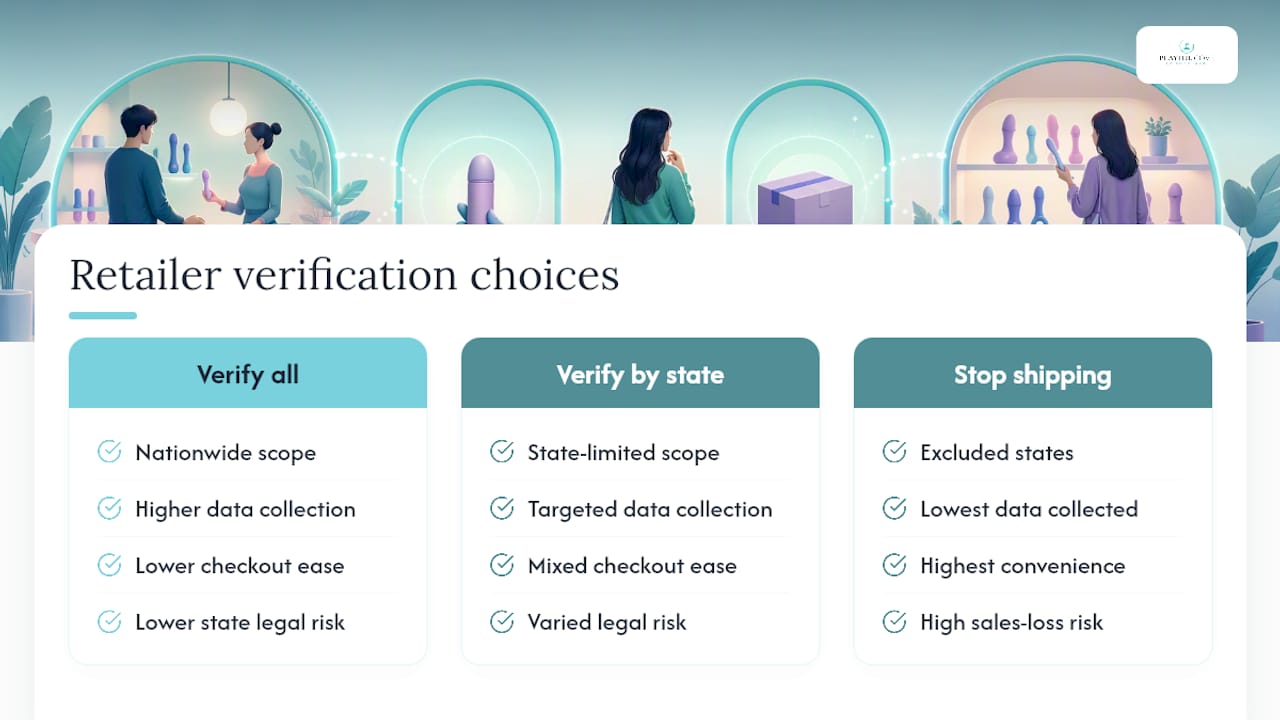
Retailers facing new verification mandates generally choose one of three paths: verify everyone the same way regardless of location, target verification only to states that require it, or simply stop shipping to states where compliance costs outweigh the sales. Each choice trades off differently between customer privacy, convenience, and legal risk.
That trade-off is the real story behind these laws. Verification protects minors, but heavier ID requirements also mean adult shoppers are handing over more personal data than they used to. The retailers worth trusting are the ones minimizing what they collect and being upfront about how it’s used, a point echoed in industry analysis of adult verification technology.
For Minors and Guardians: Safety, Privacy, and What to Do Instead
If you’re under 18 and curious, the honest answer is that most retailers won’t sell to you, and for good reason: product safety and legal compliance both assume an adult buyer. That doesn’t mean there’s nothing useful to know while you wait.
- Stick to body-safe materials. Look for medical-grade silicone, glass, or stainless steel once you are old enough to shop. Avoid porous materials that can’t be fully cleaned, and never share toys between people without a barrier method.
- Understand the payment loophole isn’t a safe workaround. Using a guardian’s card or account to bypass an age check can create real household trust issues, and in some states it doesn’t actually shield anyone from the law’s intent, according to community discussion on Scarleteen’s forum.
- Talk to someone you trust. Guardians who keep the conversation factual and judgment-free tend to get better outcomes than ones who rely purely on store policy to do the parenting for them.
- Use vetted sexual-health resources. Organizations like Planned Parenthood publish plain-language guidance on safety and product basics that’s worth reading regardless of age.
Pro Tip: Guardians: a locked conversation beats a locked cabinet. Kids who feel safe asking questions are far less likely to take unsafe shortcuts.
Why Playful Cove Takes Age Compliance Seriously
Trustworthy retailers don’t treat age verification as an afterthought bolted onto checkout. Playful Cove is built as a U.S.-based retailer for adults, with a clear age-policy page, discreet outer packaging, and product-safety information attached to every listing so shoppers know exactly what material they’re bringing home. That curated approach extends to educational resources meant to help adult shoppers, not just sell to them. Compliance questions deserve real answers, not a canned FAQ, and readers with specific concerns are welcome to reach out to support directly before placing an order.
Ready to Shop? Here’s What Adult Buyers Should Know
If you’ve confirmed you’re 18 or older and you’re ready to explore, Playful Cove keeps things simple and private. Every order ships in discreet packaging with no obvious branding, and the checkout process is built around U.S. compliance standards rather than the bare-minimum self-attestation checkbox some sites still rely on.

Browsing by category makes it easy to find something that fits, whether that’s a first-time pick like the Jelly Mini Rabbit Vibro Wand or something more adventurous like the Naked Addiction Silicone Rechargeable Thrusting, Vibrating, and Rotating Dildo. Every product page lists the material, care instructions, and what to expect, so you’re never guessing what you’re buying. If you have questions about age policy, shipping discretion, or product safety before you commit, reach out to support first. Otherwise, pick a category that fits your curiosity and place your order; it’ll arrive quietly, exactly as expected.
The Bottom Line on Age and Sex Toy Purchases
There’s no federal number to memorize here: 18 is the practical standard almost everywhere, but your specific state and the retailer’s own policy can move that bar. Three things to actually do with this information:
- Check your state’s statute before assuming a national rule applies to you.
- Read the retailer’s age-verification page before you shop, especially online.
- Prioritize body-safe materials and honest communication over shortcuts, regardless of where you land legally.
For anything you want to verify yourself, the primary sources are public and worth a direct read rather than taking a blog’s word for it.
Why the “Just Check the Store Policy” Advice Misses the Point
Most articles on this topic stop at “18 is standard, check your local law,” as if that’s the end of the analysis. It isn’t. The more interesting problem is that age verification law is currently being written faster than most retailers can implement it responsibly, and that gap is where real risk lives, not in the number itself.
Texas’s SB 3003 is worth watching closely because it’s a preview of what other states will likely copy. Once one state proves that mandatory ID verification for adult product sales is legally and technically feasible, the incentive for others to follow drops the cost of adoption. That’s good for keeping minors out of adult commerce. It’s also going to mean adult shoppers hand over more personal data at checkout than they do today, and not every retailer will handle that data with the same care.
The honest advice isn’t “wait for the law to tell you what to do.” It’s “choose retailers now that are already built around minimal data collection and clear compliance,” because those are the ones that will adapt smoothly when stricter rules arrive, rather than scrambling and cutting corners on customer privacy to stay compliant. That distinction should matter more to shoppers than it currently seems to.
Sources
- Age verification for adult content websites (Incode blog)
- Sex toys (Planned Parenthood)
- SB 3003 bill text (Texas Legislature PDF)
- Texas Bill Would Require Age Verification for Online Sex Toy Sales - XBIZ
